Saturday, July 23, 2005

Americans are angry


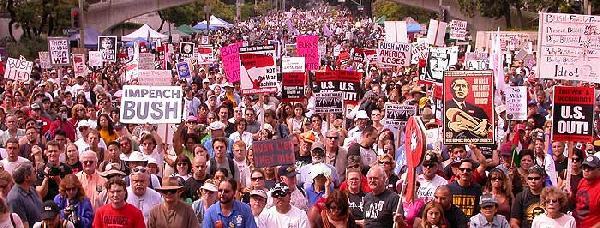
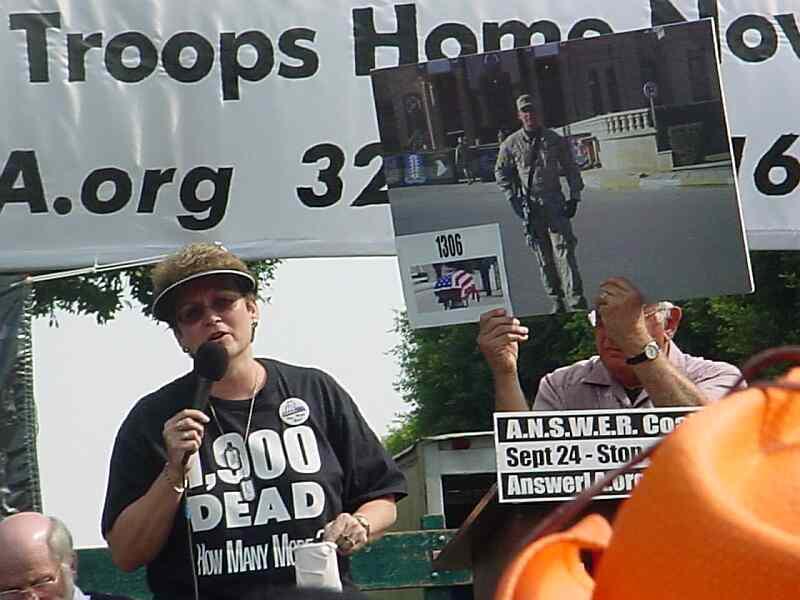
Images from anti-war protests staged on Sept.24, 2005. The article was written on July 23, 2005
PV Vivekanand

AMERICANS are angry, and the fury is growing. Soon something will have to yield, and the entire facade of the deep conspiracy and deception that went into hoodwinking them into accepting the invasion and occupation of Iraq as legitimate would collapse. That is what one realises when browsing through the thousands of websites that have sprung up to carry many objective and in-depth anayses and comments. No mainstream media are touching the real story of deception of which the unfolding details of how senior officials in the Bush administration stopped at nothing and pulled all the plugs in their desperate effort to build a non-existent case against Iraq. Exposing an undercover operative of the Central Intelligence Agency (CIA) is only one of the classic examples of the neoconservatives' desperation, writes PV Vivekanand.
It now seems to be a certainty that Karl Rove, a senior adviser to US President George W Bush, had revealed the name of the undercover CIA operative to the Time magazine as welll as columnist Robert Novak. Time magazine's reporter, Matt Cooper, has also revealed that Vice-President Dick Cheney's aide Lewis Libby was another of his sources.
Linked to the same case is Judith Miller, The New York Times reporter, who was the main conduit for then Iraqi exile Ahmed Chalabi to plant false information in the US media. Miller is being praised as a heroine for opting to go to prison rather than reveal her sources in connection with the same case although she did not write about it.
However, American writers point out, the media which have been paying tribute to Miller's "courage" are clearly overlooking the fact that she is in prison not because of a stand against revealing sources but for a different reason.
Miller is in prison to protect someone high up in the Bush administration or someone who was there. It could be anyone, including the president, the vice-president or one of their powerful aides, including some who are now occupying high international positions and a revelation that they had revealed the name of the CIA operative to a journalist could have far-reaching consequences to their present status.
Not many journalists and commentators in the US are impressed by Miller, as their comments on various websites indicate. They are asserting that if Miller were to uphold the high ethics of journalism and freedom of the press, then she should have exposed the Bush administration's deceptive campaign to wage war against Iraq.
She is well-known for her expertise with the Middle East, and it should not have been a secret to her that the administration was determined to invade and occupy Iraq much before the actual invasion and that the scene was being prepared for it through deceptive means.
A suggestion, direct or indirect, explicit or implicit, never came in any of Miller's writings in the run-up to or during or after the invasion of Iraq that Washington had made up its mind to seal Saddam Hussein's fate even when it was dilly-dallying with the UN about weapon inspections in Iraq.
Instead, she steadily helped channel to her paper a flow of unverified information — now we know it Chalabi was her source — about Saddam's non-existent weapons of mass destruction, her critics point out.
The legality of the right of journalists to protect their sources is being debated in Washington now, and several members of Congress known to have strong links with the neoconservative camp are trying to introduce legislation that offers protection to journalists who refuse to reveal their sources.
Obviously, the Rove-Libby case is only the tip of an iceberg. Much deeper and intriguing plotting and planning has gone into setting the deceptive path towards the war against Iraq. And those who want to introduce legal protection for journalists refusing to reveal sources might perhaps be ensuring protection for themselves when more skeletons tumble out from the shelves of the Bush administration.


No one doubts that there was a grandiose scheme that went to paving the way for the US-led invasion and occupation of Iraq and it was helped by many media outlets which, wittingly or unwittingly, sidestepped journalistic ethics, principles or code of conduct in their anxiety to help the neoconservatives to build the case for war.
We should have known this week whether Miller was protecting Karl Rove, Lewis Libby or someone else. But it has not happened.
Time reporter Cooper has already revealed that Rove was the first to tell him that the wife of former ambassador Joseph Wilson was an undercover CIA operative and she was instrumental in sending Wilson to Niger to investigate claims that Saddam Hussein had bought nuclear material from that country.
Cooper has also disclosed that Libby was another of his sources.
Now that both Libby and Rove have been named, it was logical that Miller would opt to admit that either of them or both of them were her sources too and get herself released from prison.
Her imprisonment could last for another three months if she continues to refuse to reveal her sources. Since she did not grab the opportunity offered when Copper named Rove and Libby, she is seen as definitely protecting someone else, and this opens up yet another chapter of deception at the highest levels in Washington to set the stage for war against Iraq.


In legal terms, both Rove and Libby could be charged with treason because they exposed an undercover CIA operative. Had the woman concerned been a regular employee of the CIA, there would have no such charge, but exposing an undercover agent is a serious crime.
That a senior White House official would go to the exent of committing such a crime is only a reflection of the determination to invade and occupy Iraq, many Americans argue.
Boston Globe columnist Derrick Z. Jackson writes that the election victory of Bush in 2000 was the hardliners in Washington were waiting for in their gameplan to invade and occupy Iraq.
According to Jackson, "Libby, Cheney, and the other influential right-wing hard-liners, such as Donald Rumsfeld, Paul Wolfowitz, Richard Armitage, Richard Perle, and Douglas Feith, saw their dreams come true" when Bush was elected.
He notes that Cheney was defence secretary in the administration of Bush Senior and Libby and Wolfowitz were two of his aides who, after the first Gulf war left Saddam in power, drafted a document advocating ‘‘pre-emptive’’ war against possible threats.
They said the United States should be ‘‘postured to act independently when collective action cannot be orchestrated," notes Jackson. But their plans had to be held in abeyance because Democrat Bill Clinton won the 1991 elections and occupied the White House for the eight years beginning in January 1992.
"But when the junior Bush became president in 2000, the hard right on foreign policy took the helm," writes Jackson. "They used the terrorist attacks of Sept. 11 as an excuse for invading Iraq, even though President Bush’s own 9/11 Commission found no tie between Saddam and 9/11.
"Libby was in the thick of whipping up fear over the thinnest of evidence. The level to which Libby and Cheney stooped to get their war was highlighted by the momentous presentation of Saddam’s 'threat’' before the United Nations Security Council by then secretary of state Colin Powell.
"Powell gave a presentation six weeks before the war where he said, 'every statement I make today is backed up by sources, solid sources. These are not assertions.’ Those assertions resulted in grudging acceptance of the war from many Democrats.
"Virtually all of Powell’s solid sources fell apart when the United States turned Iraq upside down, killing thousands of Iraqi civilians in the process. He would have looked much worse had he listened to everything Libby and Cheney tried to feed him."
Jackson concludes: " Libby may end up as a symbol of a government so driven to ignore the truth it was willing to resort to dirty tricks to stop anyone from telling it."
Why was the uranium-from-Niger deception so important for the Bush administration that its senior officials went far out of their way to discredit the Wilsons?
Ambassador Wilson exposed a particular lie that played an essential role it played in the administration’s plans for war against Iraq. 
Wilson pulled the rug from under the argument that Iraq was on the verge of acquiring nuclear weapons. The argument was one that the administration wanted to flash before Congress and convince it into approving war on Iraq. 
Indeed, the "intelligence" on the non-existent Niger connection came from the British government, the White House's main partner, but even London had doubts over the authenticity of the information.
But it was a windfall for the neoconservative camp. The neocons charged up the spin-machine in Washington and soon it was taken for granted in the media that Baghdad was reconstituting its nuclear weapons development programme. 
Then came Wilson's bombshell, and no one in the neocon camp was willing to forgive him for upsetting the war wagon going to Baghdad, and hence the former ambasasdor and his wife had to pay a big price, and they paid it indeed.
What is deplorable is the way the administration continues to play phantom and insist that it was right all along and there was nothing wrong — notwithstanding that all its justifications for the Iraq war were lies, that it led the US and some of its allies into an illegal war where thousands of American soldiers have been killed and maimed — not to mention tens of thousands of Iraqis — and spent more than $200 billion of American taxpayer's money.
What is precisely the Wilson and CIA angle to the campaign of deception and lies?
It is simple and straight.
Wilson was sent by the CIA to Africa in 2002 to investigate claims that Saddam tried to buy uranium from Niger — a claim that was central to the White House justification for its invasion of Iraq that Saddam was building nuclear-arms capability.
Wilson conducted the investigation and reported back that there was no basis whatsoever for the claim. Well, it was not what the White House wanted and he was told to keep quiet.
However, the administration continued to maintain that Saddam was seeking nuclear material from Niger. Bush himself made that claim in public in his 2003 State of the Union address.
Obviously, Wilson was shocked by the blatant deception, and wrote an op-ed piece in The New York Times critical of the administration's strategies and exposing the deceit.
Wilson's article asked the question: "Did the Bush administration manipulate intelligence about Saddam Hussein's weapons programmes to justify an invasion?"
At this point, he became an enemy of the administration, and it was time to punish Wilson for blowing the whistle and also to set an example for others like the former ambassador who had known of the campaign of deception at various levels. That punishment came in the form of exposing Wilson's wife Valery Plame as an undercover CIA operative.
Apparently, Rove suggested to Cooper that it was because of his wife's CIA influence that the former ambassador was assigned to investigate the Niger nuclear claim. The revelation was purportedly aimed at discrediting Wilson, but, in the bargain, his wife was named as a CIA undercover agent.
Obviously, the administration saw the stakes in the game as too high not to allow Wilson to get away with revealing its deceptions over Iraq and also sought to set a deterrent against others with similar thoughts. That is why someone like Rove went to the extent of exposing an undercover CIA agent that would have much deeper impact within the intelligence community. Exposing an undercover operative could lead to exposing many others. In this case, it is known that at least one "foreign undercover agent" of the CIA was executed by the host government because that agent was also exposed when Valery Plame was named a CIA agent. The damage to US intelligence operations could be vast, and no one is talking about it, at least not yet.
It should indeed be a shock to the American people that senior officials in their government were party to compromising intelligence and undermining the country's national security interests.
And we are hearing more and more from the American people expressing their anger and indignation over how they were taken for a ride in the Iraq context.
The first published account that Plame was a CIA operative came in a syndicated column written by Robert Novak, but he got off the hook by making a deal with the special prosecutor assigned to investigate the "leakage."
In his column, Novak identifed Valerie Plame as a CIA agent. He suggested that her influence had been used by Wilson to get the assignment to verify the Niger claim and torpedo the mission for his own narrow partisan ends. Novak cited as sources "two senior administration officials."
Plame was assigned to the CIA's Non-Proliferation Centre, an organisation of analysts, technical experts and former field operatives who work on detecting and, if possible, preventing foreign proliferation of weapons of mass destruction.
Novak wrote: "Vice President Cheney and his chief of staff, Lewis 'Scooter' Libby, met with officials at the Non-Proliferation Centre before the invasion of Iraq to discuss reports that Iraq was seeking to buy uranium in Africa. A US official with knowledge of those meetings said Plame did not attend. But the former US intelligence official said she was involved in preparing materials for those meetings."


Then came the Time magazine report written by Cooper revealing Plame's name and an investigation was launched into who leaked the name. What we are hearing today is the continuation of that episode.
What was Miller's "crime"? She revealed that a White House official had mentioned the name of Plame, although she did not write about it.
And when the investigation was launched, Miller refused to reveal whom she'd talked to and that was why she was sent to jail. Novak was spared because of his deal with the investigator. Cooper tried to put up a fight, but ultimately he agreed to reveal his source to a grand jury and thus avoided going to prison like Miller.
A close look at Miller's writings since Sept.11, 2001 indicates that she had contributed much to building the non-existent case for war against Iraq by accepting whatever lies were fed to her of Saddam's weapons of mass destruction. Of course, she might not have known that these were lies. But, surely, a journalist with decades of experience behind her would have definitely tried to verify some of the information. Obviously, as The New York Times had to admit later, the paper did not do justice to the mandatory process of verifying some of the reports.
But why would Miller persist in carrying the deceptive "details" that Chalabi provided her?
Well, the answer might perhaps be found in a March 18, 2002 letter revealing a conversation that took place between the former British ambassador to the US, Sir Christopher Meyer, and one of the architects of the Iraq war —  Paul Wolfowitz, often described as the most hawkish among the neoconservatives who planned the Iraq war eight years earlier (in a recommendation to Israel) and implemented the plan in 2003.
Meyer wrote to British Prime Minister Tony Blair on a meeting he held with Wolfowitz:
"We backed regime change, but the plan had to be clever and failure was not an option."
It was written one year before the US launched the invasion of Iraq.
Beyond that is the direct reference that Wolfowitz made to Chalabi's Iraqi National Congress (INC).
Meyer observed in the letter that Wolfowitz insisted that the INC should not be discredited despite warnings from Meyer.
"When I mentioned that the INC was penetrated by Iraqi intelligence, Wolfowitz commented that this was probably the case with all the opposition groups: It was something we would have to live with..."
(Indeed, it was Wolfowitz who insisted that Bush include a statement that Iraq tried to buy uranium from Niger in his State of the Union address despite a CIA warning that the information was unreliable and could not be verified.
“The British government has learned that Saddam Hussein recently sought significant quantities of uranium from Africa,” Bush said in his address.
No doubt, the statement was technically correct because it accurately reflected a British intelligence report. However, the White House knew it was information that the CIA had explicitly warned might not be true.
That was the level of desperation of the Bush administration to build the false case for the war against Iraq).
Is there any connection with Wolfowitz's "obsession" with Chalabi and the false information the INC chief provided to Miller that unfailingly found its way to The New York Times?
Is Miller trying to protect Wolfowitz, who is now president of the World Bank?
The web of lies is spread far and wide. Among the officials who played a key role in creating the so-called Niger file and added it to Washington's case for war against Iraq was Under Secretary of State for Arms Control and International Security Affairs John R. Bolton , according to Representative Henry Waxman, a ranking member of the House Government Reform Committee.
The document was part of an American presentation countering and discrediting a Dec.7., 2002 Iraqi disclosure about its weapons of mass destruction programme.
On Dec.19, 2002, the State Department issued a fact sheet entitled "Illustrative Examples of Omissions from the Iraqi Declaration to the United Nations Security Council."
Under the heading "Nuclear Weapons," the fact sheet stated:
The declaration ignores efforts to procure uranium from Niger.
Why is the Iraqi regime hiding their uranium procurement?
Waxman says he was told by the State Department in September 2003 that Bolton had no role in creating the document.
However, says Waxman, there is evidence that Bolton was specifically asked for help to counter the Iraqi declaration and Bolton assigned the work to "the Bureau of Nonproliferation," a subordinate office that reports directly to Bolton.
Is Miller protecting Bolton, who is nominated by Bush to be the next US ambassador to the UN?
We don't know yet who Miller is trying to protect and we could only take a wild shot at it, but we don't have to do that to know what she is not protecting.
The fury of the American people are showing in cyberspace.
Here is a classic example (http://wuamericaru.blogspot.com):

"The current Administration has done its very best to mangle, tear asunder, or annihilate: our constitutional rights, our freedoms and liberty, our privacy, America's standing in the world, the economy, the environment and ways of protecting it, the healthcare system and Medicare, Social Security, sound education and student development, the quality and safety of the agriculture industry and our food and water supply, proper judicial procedures, the peoples' right to know what their "duly elected" government is really doing. This is just a short list.
"The way in which the administration has imposed its whims and will over the entire country — and certain parts of the world that don't need mentioning — in a seemingly carte blanche manner, is very frightening and disturbing. It is troubling that a country founded on a premise and a philosophy of democratic, citizen-run government can devolve into a shell of its former self, with dangerous, avaricious, and bloodthirsty individuals and groups filling the void. On the outside, everything looks peachy keen. When one gets to the heart of the matter, however, they can see the slow, painful, and agonising death of the greatest country that ever was."
Justin Raimundo, a well-known anti-war activist and commentator, puts in a better perspective (www.antiwar.com/justin):
"What we are witnessing is an insurgency arising to take back Washington from the occupiers. It is a two-pronged legal assault, launched from within the FBI and the Department of Justice by patriotic Americans who mean to take back their country from the invader. That is the meaning of the Plame investigation and the AIPAC-Larry Franklin spy case. The battlefield is not Baghdad, it's an American courtroom: the weapon of choice is not the RPG but the subpoena. As the prosecutor-insurgents inch slowly toward the White House, occasionally scoring direct hits inside the Green Zone, the panic begins to spread: talk of "staying the course" is tempered by hints of negotiations and rumours of withdrawal. Donald Rumsfeld tells us that the Iraqi insurgency could last a decade or more, but the Washington version is likely to end much sooner — in a clear victory for the insurgents."


With inputs from website sources

Saturday, July 02, 2005

Unrealistic deadlines

The dice is loaded


WASHINGTON has set a mid-July deadline for Iraq's former prime minister Iyad Allawi to finalise a deal with the country's Sunni community to at least partially contain the ongoing insurgency there. The Bush administration is pinning high hopes that Allawi would succeed in his mission. Allawi is holding marathon meetings in Amman, Jordan, with Iraqi Sunni leaders who travel there upon his invitation, according to intelligence reports.
Allawi is seeking to convene a Sunni Arab Congress grouping some 250 delegates representing all Sunni factions, parties and guerrilla groups. They will be invited to enter Iraq’s mainstream political process.
Allawi is backed in his mission by Sunni Defence Minister Saadoun Al Duleimi.
The optimism that Allawi would be able to finalise a deal with the Sunnis is seen behind the upbeat note in the speech US President George W. Bush made on June 28 at the US air base at Fort Bragg, North Carolina. Bush said that he was not making any major change in his approach to the insurgency in Iraq but that he had a plan to end the crisis in the beleaguered country where dozens of Iraqis are being killed on a daily basis. He assured Americans that he would win the war in Iraq.
According to the sources, Washington retained Allawi as its pointman Iraq even after his party failed to secure enough seats in the Jan.30 elections that produced a new government with Kurdish leader Jalal Talabani as president and Shiite Ibrahim Jaafari as prime minister.
The mainstream Sunni community stayed away from the elections and are not represented in the government. Washington wanted to address that through nominating a few Sunni leaders, but Shiite rejection of that strategy scuttled the American plan.
Since then Allawi, a Shiite with strong connections with the Central Intelligence Agency has been trying to convince the Sunnis into dropping their boycott and joining the process of drafting a constitution leading to new elections for a government on the basis of that constitution.
Since the Jaafari government took office in April, more than 1,000, most of them Iraqis, have been killed in the insurgency.
While Allawi is tasked with dealing with the Sunni community, the US military is focusing on the non-Iraqi Jihad component of the insurgents said to be led by Abu Musab Al Zarqawi, a Jordanian militant affiliated with Osama Bin Laden's Al Qaeda.
Allawi has enlisted the help of Jordan and Egypt as well as the Arab League in his mission. He visited Cairo on June 24 and held talks with President Hosni Mubarak and Arab League Secretary-General Amr Moussa. Both supported his mission.
A recent call by the grand mufti of Al Azhar, the highest Sunni authority, on the insurgents in Iraq to suspend their attacks was seen as linked to Mubarak's endorsement of Allawi's mission.
According to the sources, Allawi visited Syria on June 23 and held talks with President Bashar Al Assad, but the response from Damascus to his appeals for a total blockade of jihadist volunteers entering Iraq through the porous border was not seen to be very positive.
The Syrians categorically denied that they were party to the infiltration to Iraq and pointed out that they had co-operated fully with the US forces in recent operations against Zarqawi near the frontier.
Jordan has also endorsed Allawi's mission. Allawi was based in Amman during the last decade of Saddam Hussein's reign in power and he had developed close contacts with senior Jordanian leaders. National security adviser General Saad Kheir is said to be in charge of the Jordanian liaison officers carrying messages back and forth between the Iraqi parties.
Among the people Allawi has already met in Amman were some leaders of the militant Ansar Al Islam movement, which has claimed responsibility for scores of attacks against the US-led coalition forces in Iraq as well as kidnappings (Jordan has given an undertaking that it would not seek to detain any visitors to Allawi in Amman even though they might be wanted for anti-Jordanian activities in Iraq).
Ansar al Islam was upset when the contacts with Allawi were leaked to the media and therefore it hastily issued several statements reaffirming its commitment to jihad.
Washington is not hoping for a complete end to insurgent attacks on the basis of agreements hoped to be worked out at the proposed Sunni congress. It is only expecting to convince the mainstream Sunni leaders to stay away from the insurgency and refuse to align themselves with non-Iraqi jihadists like Zarqawi.
If that mission is accomplished, according to the American strategy, then it would make it easier for the US military in Iraq to hunt down jihadists and eliminate them.
Bush, who has said he did not think he needed to send more troops to Iraq to suppress the insurgency, should but be aware that there is no military solution in Iraq and hence he is betting on Allawi's success.
However, the reality on the ground suggests Allawi would not be able to make much headway either.
If anything, the intensity of the insurgency has only grown in recent weeks. It was based on this realisation that US Defence Secretary Donald Rumsfeld made the gloomy assessment that insurgencies tend to go on for six, eight, 10, 12 years.
US Middle East commander General John Abizaid recently told a Congressional panel that the Iraqi insurgency was still running with the same intensity and foreign fighters were continuing to join the war at the same level that existed six months ago.
Other factors that undermine Allawi's mission include the pattern that has emerged in Iraq under which the Sunni leaders engage themselves in political talks with mediators but also continue to support the insurgency — "they keep shooting and speaking at the same time" as one source puts it."
Another is the ambitions of the Shiites and Kurds to consolidate their newfound prominence in pos-Saddam Iraq at the expense of the Sunnis. Both communities are expanding their respective spheres of influence in the south and north and this has narrowed the Sunni options to central Iraq and the area is fast shrinking.
The US has not been able to influence Iran into suspending its alleged clandestine operations in support of the insurgents. American strategists argue that the conservative Shiite theocrats of Tehran and Qom are aware that American gunsights would be trained against them if the US military is allowed to stabilise Iraq and therefor continued instability in their western neighbour is deemed to be a necessity for their survival in power.
Both President Talabani and Prime Minister Jaafari as well as the Kurdish and Shiite camps they represent are not very enthusiastic about giving more weightage to the Sunnis in governance and this also is seen as working against Allawi's mission.
What all these boil down to is simple: The US is severely handicapped in its effort to pacify Iraq. More and more volunteers are turning up to fight the US-led coalition forces and Iraqis seen aligned with them, including the more than 160,000 ill-trained soldiers. The killing and maiming of a few insurgents here and there are temporary victories since those challenging the US presence in Iraq are fighting the war without any rules and resort to most unexpected tactics.
"The solution is more political than military at this point," according to Michael O'Hanlon, who heads the Iraq Index project at the Brookings Institution. "We do need to improve safety on the streets, to get the politics working to our advantage, but most of the solution is to get the Sunni Arabs aboard the political process," he recently told San Francisco Chronicle.
That is what Allawi is trying to do and this why Bush is hoping against hope that Allawi would succeed. However, the mid-July deadline is unrealistic. Allawi had been in touch with the Sunnis since he took over from US administrator Paul Bremer in June 2004 and has not made much headway, and there are only negative signals coming out of Iraq for any deadline for the Sunnis to sign on his proposals.

Thursday, June 30, 2005

Attempt at tearing the veil

June 30 2005
Attempt at tearing the veil

AN INTENSE campaign is under way in cyberspace to support a move by US Congresswoman Barbara Lee (Democrat - California) to force the Bush administration to reveal whether it had decided to invade and occupy Iraq by mid-2002 — months before it sought congressional approval for military action against Saddam Hussein.
Lee has submitted a resolution of inquiry into this effect to the House of Representatives and the motion has been referred to the assembly's Committee on International Relations.
If adopted, the motion will require the White House and the State Department to transmit to the House of Representatives not later than 14 days after the date of its adoption all information relating to communication with officials of the United Kingdom between Jan.1, 2002, and Oct.16, 2002, relating to the policy of the United States with respect to Iraq."
The resolution is supported by 26 other members of the House of Representatives.
In formal terms, President George W Bush and Secretary of State Condaleezza Rice would be required to provide "all documents, including telephone and electronic mail records, logs, calendars, minutes, and memos, in the possession" of the president and secretary of state relating to communications with officials of the United Kingdom from Jan.1, 2002, to Oct.6, 2002, relating to the policy of the United States with respect to Iraq, "including any discussions or communications between the president or other administration officials and officials of the United Kingdom that occurred before the meeting on July 23, 2002, at 10 Downing Street in London, England, between Prime Minister Tony Blair of the United Kingdom, United Kingdom intelligence officer Richard Dearlove, and other national security officials of the Blair administration."
Proponents of the resolution are asking Americans to support it by pressuring their respective members of congress into not only voting in its favour but also explain in the House of Representatives why if they do not favour it.
"Tell them that you will not vote for anyone that votes against the inquiry," says a comment appearing on www.whatreallyhappened.com.
The motion is linked to the minutes of a secret meeting held at the British prime minister's office on July 23, 2002 that have come be known as the "Downing Street memo." It quotes Richard
Dearlove of the MI6 intelligence agency as telling the meeting that he had found in talks with American officials that the Bush administration had already taken a decision to invade Iraq and was intelligence reports to be doctored to justify the decision. It was not until October 2002 that the administration secured congressional approval for military action against Iraq in the pretext that Saddam Hussein had an arsenal of weapons of mass destruction (WMD) and posed a direct threat to the national security of the US.
The memo states that by the summer of 2002, President Bush had decided to overthrow Saddam by launching a war which, Dearlove reports, would be "justified by the conjunction of terrorism and WMD."
Dearlove continues: "But the intelligence and facts were being fixed around the policy." Dearlove also told the meeting that "there was little discussion in Washington of the aftermath after military action."
British Foreign Secretary Jack Straw told the same meeting that "it seemed clear that Bush had made up his mind to take military action, even if the timing was not yet decided." "But," he continues, "the case was thin. Saddam was not threatening his neighbours, and his WMD capability was less than that of Libya, North Korea, and Iran."
The White House and State Department have withheld direct comment on the memo. President Bush evaded a direct answer to a question put to him at a joint press conference with visiting Blair a few weeks ago. He maintained that he had always sought a "peaceful" solution to the Iraq crisis and it was only when all options were exhausted, including UN involvement, that he decided to take military action.
If the Downing Street memo reflects the reality — as its proponents believe it does — then it would be established that the president lied to the US Congress.
The Bush administration would not be able to block the release of all communications in the Iraq context made between Jan.1 2002 and Oct.6, 2002 if the US Congress asks it to do so. And those communications would clearly reveal whether the contention made by Dearlove was accurate, the proponents of the Lee resolution say.
A group of nearly 120 members of Congress has submitted a call on the White House to make a formal comment on the Downing Street memo, but the administration has not responded to it.
A flyer accompanying the text of the Lee resolution appearing on www.afterdowningstreet.com is calling on Americans to their congress members to co-sponsor the motion.
The resolution must be voted on in committee within 14 legislative days of its introduction.
The Republicans, who control the House of Representatives International Relations Committee, may take the matter up right away, hoping to vote it down before Congress takes a recess in August. If they do not, they will be required to take it up by Sept.16. The more congress members in the full House of Representatives who co-sponsor the resolution, the more likely committee members are to vote for it.
The appeal on the web site urges that committee members should be asked not only to vote for it but to discuss it at length and engage in a substantive debate when the committee meets, so that members who oppose it have to explain their reasons.
"This resolution is important because the information in the Downing Street documents so strongly suggests that President Bush intentionally deceived Congress about the reasons for war, " it says. "If that is not the case, then releasing the documents requested here will clear that up — something the president should be eager to do."
If the Republicans in the US Congress somehow manage to vote down the resolution, then it would clearly be established that the Bush administration has something to hide in its communications with the Blair government. Thus, the White House is caught in its own trap. It could not afford to release the sought for documents because it would establish the case against the administration. In the other hand, blocking the congressional motion would signal an affirmation that the allegations that the administration had decided to wage war against Iraq but not only kept the elected representatives of the people in the dark but also lied to them.
But then, that is only the tip of the iceberg, given that other documents have surfaced indicating that the Bush administration was planning a premeditated attack on Iraq to secure "regime change" even before Bush took power in January 2001.
That document, which calls for the creation of a "global Pax Americana" was drawn up for Dick Cheney (now vice- president), Donald Rumsfeld (defence secretary), Paul Wolfowitz (formerly Rumsfeld's deputy), George W Bush's younger brother Jeb and Lewis Libby (Cheney's chief of staff). The document, entitled Rebuilding America's Defences: Strategies, Forces And Resources For A New Century, was written in September 2000 by the neo-conservative think-tank Project for the New American Century (PNAC).
The blueprint shows that the Bush camp planned to take military control of the Gulf region whether or not Saddam Hussein was in power. "The United States has for decades sought to play a more permanent role in Gulf regional security," it says. "While the unresolved conflict with Iraq provides the immediate justification, the need for a substantial American force presence in the Gulf transcends the issue of the regime of Saddam Hussein.'
If pursued with vigour and determination, the Lee resolution offers the American Congress and people the opportunity to tear the veil away from the real story of the invasion of Iraq. Both sides seem to have realised it, and we could expect to see a bitter battle in the US Congress, both in public and behind--the-scenes, but all bets are off on the outcome.

Sunday, June 26, 2005

No timetable (ever)

June 25, 2005

No timetable (ever) for US pullout

AMERICAN public have started taking serious notice of the crisis their country is facing in Iraq. That much is clear. What is not clear to them is how long would their military remain in Iraq and continue to take casualties. And hence the demand on the Bush administration to set a clear timetable for withdrawal from the country.
US President George W Bush had more of Americans in mind than the Iraqis or the rest of the world when he asserted on Friday that he would set no timetable for recalling the US military from Iraq.
US Defence Secretary Donald Rumseld wants Americans to be patient and support their troops in Iraq. He has put the onus on Iraqi security forces to quell the insurgency and suggests that the crisis could go on "for five, six, eight, 10, 12 years.''
"Coalition forces, foreign forces are not going to repress that insurgency," he said on Sunday. "We're going to create an environment that the Iraqi people and the Iraqi security forces can win against that insurgency.''
Well, that approach clearly set the background for an indefinite American presence in Iraq since it is wishful thinking that Iraqi security forces would ever be able to effectively counter the insurgency and bring the country under their control.
An ABC News/Washington Post poll ahead of a key speech on Tuesday in which Bush was to seek public support for the war found that 53 per cent of Americans who were surveyed said the war was not worth fighting.
A record 57 per cent said the Bush administration "intentionally exaggerated its evidence that pre-war Iraq possessed nuclear, chemical or biological weapons."
What American leaders, including Bush and Rumsfeld, are not touching is the reality, as could be seen from the Mideast vantage point as far back in early 2002, that the US has no plans to quit Iraq in the foreseeable future.
In fact, there is no question of the US military leaving Iraq. Period.
There are several reasons to arrive at that conclusion:
The invasion and occupation of Iraq had more to do with the American question for global dominance than Saddam Hussein's oppression of his people; let us only mention that since the world knows of the hollowness of claims that Saddam had weapons of mass destruction, had played a role in the Sept.11 attacks in the US and posed a direct threat to the security of the American people.
Having invaded and occupied Iraq, the US is no position to quit the country now. Ending the military presence in Iraq would mean a serious blow to Washington's long-term plans in the Middle East in all aspects — politics, military, energy-linked economy and global dominance. It would be humiliating for the US to leave Iraq now and would send what Washington would see as wrong signals to countries like Iran, Syria and even North Korea.
So it is clear that neither Bush nor Rumsfeld or anyone else in the current US administration means a withdrawal from Iraq while they do talk about it abstract terms.
What we are seeing today is a continuation of the same strategy of fitting or creating conditions to justify the arguments as indeed the Bush administration did in the run-up to the March 2003 war. That has clearly been established by the Downing Street memo — minutes of a July 2002 meeting where Britain's spychief reported to Blair and others in a secret meeting that the US was determined to go to war against Iraq and topple Saddam and that intelligence reports were being "fixed" to suit that goal.
Surely, ousting Saddam was not a goal in itself for the US, which now needs to pacify Iraq and have an American-friendly regime in power in Baghdad which will take care of US interests in the country and elsewhere in the region.
That is proving to be an impossible job because, among other things, the US failed to take into consideration many peculiarities of the Iraqi society and were almost blindfolded into Iraqi politics by Saddam opponents in exile who lied outright and convinced American strategists that they would have a clear and easy run of the country with overwhelming support from the people of Iraq once Saddam was removed from power.
The US also failed to take note that it was sending tens of thousands of its soldiers to a region where anti-US sentiments were already at a boiling point because of the lopsided American approach to the Arab-Israeli conflict.
The Washington strategists should have realised that there would be thousands of young men ready to kill themselves for a chance to take a shot at American targets in "revenge" for the American policy that they saw as heavily loaded against their interests because of Washington's support for Israel.
And now Washington is trying frantically to find a solution that would pull it out of the quicksands in Iraq, and does not necessarily mean a withdrawal from that country.
That is what US Secretary of State Condaleezza Rice actually meant when spoke on Tuesday stressing that the United States must "finish the job" in Iraq.
The "job" the Bush administration has in mind is not to bring "democracy" to Iraq although if it happens the way the US wants then it is welcome. The "job" is to drive down an American stake in Iraq that would not be pulled out in a hurry and everything else is secondary.

Saturday, June 25, 2005

What lies ahead for Lebanon

June 24, 2005

What lies ahead for Lebanon

THE PEOPLE of Lebanon, the Arabs at large and the international community are fascinated by the fast pace of events in Lebanon that has taken everyone by surprise since the Feb.14 assassination of former prime minister Rafiq Al Hariri. Many analysts tend to describe the developments in Lebanon as the "cedar revolution."
Syria has been forced to withdraw its military from Lebanon — thus ending nearly three decades of its absolute dominance of its neighbour. The country held parliamentary elections that saw the anti-Syrian opposition securing an eight-seat majority in the 129-member assembly.
And the Lebanese are set to embark on a new era in their modern history, but they have to deal with numerous wild cards that could spring surprises, writes PV Vivekanand.
With the bloc led by Saadeddine Al Hariri, son of the slain prime minister, sweeping the polls on an anti-Syrian reform ticket plus of course the sympathy factor, the stage is set for the next but crucial phase of Lebanese politics. No matter what the perspective, reshaping Lebanon's relations with Syria is one of the top priorities of the new government and that is where it might run into serious problems.
Those problems will stem from the differing priorities of the various groups that make up Lebanon's political mosaic.
According to election returns and party affiliations, the "Lebanese national opposition," a coalition led by Saadeddine Al Hariri, won 72 seats, enabling to form the next government. Hariri's coalition includes the Progressive Socialist Party of Walid Junblatt with 14 seats, the Lebanese Forces Party of jailed Samir Geagea with six seats and the Qornet Shehwan grouping with six seats.
The Shiite Hizbollah and its ally Amal won a total of 35 seats. Former general Michael Aoun, who returned from exile in May, won 21 seats after he made an alliance with pro-Syrian President Emile Lahoud when he found himself without any allies.
All groupings have differing and conflicting priorities and these could emerge with force once a government is installed, most probably with Saadeddine Al Hariri as prime minister and Junblatt as well as Geagea's wife and the widow of slain president Bashir Germayel assuming key positions.
According to analyst Dr. Walid Phares, a professor of Middle East Studies and senior fellow with the Foundation for the Defense of Democracies, the new political map is:
Hariri, a Sunni who is backed by Saudi Arabia and the US, tops the list. He is supported by Junblatt, who, according to Phares, is anti-American. The two of them "control the legislature with backing from a smaller number of Christian legislators who are historically anti-Syrian but have joined the alliance to achieve interim or tactical agendas," says the analyst.
Hizbollah and Amal stand second, and with them the remnants of the pro-Syrian regime. They will ally themselves to any government that will protect them from the implementation of UN Security Council Resolution 1559 which calls forr their disarmament.
Aoun, with the largest bloc of the Christian MPs, is third and has begun from a position of weakness, but perhaps he will emerge as the loudest voice, Phares predicts.
Aoun backs the call for Hizbollah to be disarmed but considers the confrontation with Syria over.
The Hariri camp wants to take Lebanon totally away from the Syrian orbit and set it on a course of its own while maintaining Beirut-Damascus relationship in a tight frame. It will be a delicate rope-trick since the Syrians will be closely watching every Lebanese move for signs that Beirut is succumbing to American pressure to cut a seperate peace deal with Israel without Syria having any say.
Few politicians and commentators have bothered to recall that the US had given an implicit green signal to Syria in 1990 to have its way in Lebanon in return for Damascus joining the coalition which evicted Iraq from Kuwait through war in early 1991. The US maintained that position until it became clear that Syria would not sign on the Israeli-dotted lines in a peace agreement. Syria's opposition to the US-led invasion and occupation of Iraq in March 2003 sealed the course of the American action against Damascus. Indeed, it could even be argued that Syria did not respect its side of the 1990 bargain by opposing the Iraq war of 2003.
Today, the US backs the Hariri camp as well as all other forces opposed to Syria, and there are strong indications that Washington would seek to cut Lebanon out of the overall Arab-Israeli equation and work out such a separate Lebanese-Israeli deal. Whether a Hariri-led government would be amenable to that remains to be seen.
In principle, Lebanon does not have any territorial dispute with Israel after the UN Security Council ruled last year that the Israeli-occupied Shebaa Farms area belongs to Syria and not to Lebanon.
Israel occupied the area from Syria in the 1967 war, but Damascus had since then argued that it belonged to Lebanon. That was seen as a ploy to keep Lebanon engaged in the Arab-Israeli conflict since groups like Hizbollah could wage continued resistance against the Jewish state even after the Israeli withdrawal from southern Lebanon in 1999.
The US-engineered resolution adopted by the UN Security Council did away with that.
An Israeli-Lebanese peace agreement would leave Syria on its own to deal with the Jewish state's occupation of the Syrian Golan Heights, and Damascus could be expected to fight that eventuality with tooth and nail. And here would be the key role of groups like the Shiite Hizbollah and Amal, which will block such moves.
At the same time, they would also have to withstand pressure for them to be disarmed, and the Hariri bloc seems have given them some assurance that this would not be done. However, the next item on the American agenda in Lebanon is disarming Hizbollah and Palestinian groups in camps in the south of the country. This was affirmed by US Assistant Secretary of State Liz Cheney during a meeting with Arab journalists this week.
Therefore, the tacit, temporary alliance that the Hariri camp had with Hizbollah mediated by Druze leader Junblatt will be put to test sooner than later.
In the meantime, Syria also expect increased American pressure.
That was made clear when Washington accused Syria of being behind the killing of George Hawi, former chief of Lebanon's Communist Party and a harsh critic of Syria,. It is the third prominent assassination of an anti-Syrian Lebanese figure. The first two were Hariri, who was killed in a bomb blast on Feb.14, and journalist Samir Kassis, a bitter critic of Syria, who died in a bombing this month.
While the immediate conclusion is that Syria was behind the three killings, a quick scrutiny of the realities on the ground would indicate that there is something wrong in following conventional thinking to decide that the Syrians are eliminating anti-Syrian voices in Lebanon.
In fact, Damascus and its allies in Lebanon lost a lot as a result of the killings and stand to lose much more in the days ahead.
We have seen the Syrians being forced to end its nearly 30 years of dominance in Lebanon following the Hariri assassination and international pressure mounting on Damascus to stay away from Lebanese affairs.
We know that the Syrians are not stupid or naive enough to think that they could get aay with killing people like Hariri and Kassis. They would know that the first accusing figure would be levelled against them. They would know that the US is waiting to grab any opportunity that came along to step up pressure against Syria. They would know that such assassinations would only bring immense strains on Syrian-Lebanese relations. They would also know that they would be the end losers in Lebanon.
Who benefited indirectly from the killings? Whover hated Syria's role in Lebanon and wanted to end it.
This would mean a majority of the people of Lebanon and Israel.
Are there people capable of carrying out such precision assassinations present in Lebanon? Yes, the pro-Syrian Lebanese secutity agencies.
Will they do that, knowing well that Syria will have to pay the price? No.
Then who could have done it? Anyone who has a state intelligence aparata and strong intelligence presence in Lebanon.
Who would that be? None other than Israel.
Israel got rid of Syria from Lebanon. Now, it could seek to deal directly with Lebanon away from Syrian influence and strike an agreement that removes Lebanon from the overall Arab-Israeli equation. That would also leave Syria as the last holdout against signing peace with Israel.
The killing of Hawi was strange. He was not a real threat to the pro-Syrian government; nor was he a danger to Syria itself. Lebanese media have noted that Hawi was not engaged in remarkable or delicate political activities and his ideas did not affect anybody, even if he was close to the opposition against Syrian tutelage.
"Just as Kassir's assassination took place soon after the first round of the parliamentary elections in Beirut, Hawi's assassination came after the wrap-up of the final round of parliamentary elections, as if Lebanon is destined to walk through a minefield before reaching the safe shores of freedom," wrote Beirut's Daily Star newspaper.
"All the politicians who condemned Hawi's assassination unanimously agreed the country is not secure — with or without international fostering; with the presence of a government fully subject to Syria's influence or one independent and free of Syria's hegemony," wrote the paper.
Security Forces have arrested five Syrian nationals shortly after the murder of Hawi in a car bomb. They were to be hiding on the roof of a nearby building, but nothing else was reported about them beyond that.
Junblatt, who says he fears that Syria is tageting him, asserted that "The one who doesn't want Lebanon to gain its independence and freedom and wants chaos to prevail is the one behind murdering Hawi."
President Lahoud rejected charges that he was somehow involved in the killing. He vowed to uncover those responsible for this "barbaric crime," saying all state capacities would be mobilied to achieve this goal.
"Every time Lebanon advances new steps to keep law and order, evil hands destabilise the situation again," said Lahoud.
"With regard to the persistent suggestion that the president is linked to the so-called security state, everyone knows that he does not directly supervise the security agencies," he pointed out.
What happens next in Lebanon?
There is indeed fear that any politician could be killed at any juncture and this would figure as a key consideration for any political move in the country in the days ahead. While the obvious "beneficiary" from such a state of fear is Syria — as most anti-Syrians argue — it has to be remembered that Israel, which is indeed enthusiastic that it could now play its own game in Lebanon — stands to gain the most.
In the meantime, it is highly unlikely that an objective and realistic investigation into the Hariri, Kassis and Hrawi killings would produce irrefutable evidence as to who the perpetrators were. The assassinations were professional, indicating the involvement of a state-run intelligence network; and Israel's Mossad has the best expertise and indeed experience in carrying out such actions and leaving no trace of its involvement. Regardless of whether Syria had anything to do with any or all of the killings, Damascus is targeted for American action. And we could expect the determined American action taking its course just as we saw Washington bulldozing its way into invading and occupying Iraq through deception.
Caught in the equation would be Lebanon, and it is upto the new leadership that has emerged from the elections to make the best of the situation. In order to do that, the various political forces of the country have to come together on a common platform, and that is the most daunting task awaiting them.

Monday, June 20, 2005

Rice and Arab democracy


IT WAS indeed an "important" speech that US Secretary of State Condoleezza Rice made in Cairo on Monday emphasising the need for democratic reforms in the Middle East. But it only served to emphasise the selective American vision as to who should do what and how in the region and the double standards that the US has always followed when dealing with this region.
Rice told the region's leaders not to fear their people's free choice — a great idea and concept of course. But she also used the forum to single out Egypt, Syria and Iran as countries which should transform themselves.
We all know that there are major shortcomings in the Egyptian political system, and it would take time before politicians entrenched in the corridors of power would accept the inevitability of change. There would a lot of political fireworks before the system would be open for circles other than the ruling party. The Egyptians are dealing with it, and, sooner or later, there will be changes in Egypt, but the US would not be able to impose them except in a peripheral context. The Egyptians themselves will have to take care of them.
In Syria, we have seen that the regime of Bashar Al Assad has taken serious steps towards reforms.
Assad is following a skilful political approach: He wants his people to see tangible and positive changes in their daily life in terms of living standards and, more importantly perhaps, the basic freedom of choice. He has lifted scores of restrictions that were solid features of life for the Syrians for decades. He has also initiated a series of economic reforms that would hopefully lead to better opportunities for his people.
Assad has charted a course starting with ensuring that his reforms do make a positive impact on people's life and then going on to introduce political reforms. He wants to prove it to his people that he could deliver what he promises. He has realised that only then he could hope for an absolute and unquestionable popular endorsement as the political leader of the country.
The US should accept the sequence and pace of events rather than trying to demand an overnight transformation of a political system that has existed for decades. What is it that the US wants in Syria? A French-style revolution?
Iran is a different kettle of fish altogether. For a majority of Iranians — Shiites — politics and religion go together and thus the Iranian political system does not conform to what Washington might see as ideal. The US is barking up the wrong tree by insisting on Iran having democracy of a style and shape that is acceptable to Washington. What the US wants in Iran is a sweeping change in a belief and conviction based on faith. How could that be acceptable to the Iranians? There might or might not be problems with the Iranian-style of democracy and governance, but it is the Iranians to decide what reforms they would like to accept. The US, or anyone else for that matter, has no business to dictate terms for change in any society except of course the Americans themselves (Let us not forget the resounding allegations within the US that the last presidential elections were rigged in some states. We don't recollect Rice talking about that either. Can't she do something about addressing those charges?).
Rice spoke about the people's freedom of choice. Surely, such a noble approach should be welcome to forces which are seeking changes in the Arab World.
However, we see a paradox here.
For starters, let us see how many opposition leaders — wherever they have been clearly identified — opted to join their voices to the American effort. Well, practically none.
Egypt's powerful Muslim Brotherhood, which could easily win elections if it is allowed to run as a political party and field candidates — hit the nail on the head by dismissing Rice's visit.
"We know that the US administration is not a benevolent organisation or a charity," said Mohammed Habib of the Brotherhood. "Its interests and agenda are not those of the Egyptian people."
Even the Kefaya (Enough) movement, the most active group in Egypt seeking reforms, turned down an invitation to meet Rice.
In principle, few in the Arab World dispute that the region needs reform. The Arabs agree with the US that ordinary people should have a direct role and say in the running of their affairs, but that is where the agreement stops. The Arabs are suspicious of the American agenda in the Middle East. They are aware of the American record while dealing with human rights and democracy. They know that democracy means little to the US when compared with what it considers as its strategic interests. That the US is driving for reforms in certain countries in itself is suspect because it is no coincidence that those countries happen to be hurdles in the American quest to achieve its strategic goals and serve its priorities where a genuine desire for democracy is far down the list.

Sunday, June 12, 2005

American hypocrisy


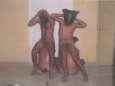
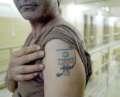
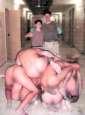
Some of the scenes from Abu Ghraib.

June 11 2005

American hypocrisy


AMONG THE conditions that the US has cited for not to withhold payments to the UN is a demand that the world body bar countries that violated human rights from UN human rights organisations. Well, if we go by what the London-based Amnesty International has to say about it, then the first country that should be kept away from UN human rights organisations is none other than the United States of America itself, followed by some of its closest allies.
The US demand is yet another milestone in the hypocritical policies adopted by the Bush administration. The world needs no pointed presentation of the systematic violations of human rights by the US.
Of course, Washington would reject the accusations and call them absurd. Perhaps, the only point, if you will, in its favour is that the rights of American citizens are not violated except those of American Muslims, particularly if they are of Arab origin.
Amnesty has recorded violations of the human rights by American soldiers, intelligence operatives, interrogators and officials. In sum, these records fully support Amnesty's description that the American detention centre at Guantanamo Bay, Cub, is a modern "gulag" — Stalinist-period labour camps and jails in the Soviet Union.
In addition are the findings that the US maintains secret detention facilities in "friendly" countries where the Central Intelligence Agency and its affiliated agencies and groups have a free hand in subjecting the detainees to any form of humiliation, torture and punishment that they deem fit.
Accodding to Amnesty Director William Shultz, "the United States is maintaining an archipelago of prisons around the world, many of them secret prisons into which people are being literally disappeared, held in indefinite, incommunicado detention without access to lawyers or a judicial system, or to their families, and in some cases at least we know that they are being mistreated, abused, tortured and even killed. And those are similar at least in character, if not in size, to what happened in the Gulag."
The US demand that the UN "reform" itself came last week with a congressional committee narrowly approving legislation. The bill says that the US would withhold half of its annual $500 million contribution unless the world body tstreamlined its bureaucracy, barred countries that violated human rights from UN human rights bodies and created an independent oversight board and ethics office.
The effort to get the bill approved was led by Henry Hyde, Republican chairman of the House of Representatives international relations committee.
He argued that the bill was the only way to force the UN to adopt reforms. “You can't have reform if you don't withhold dues," he said.
The Bush administration has said it does not approve of the legislation. However, it is not seen as resisting it either.
The Senate could take up the issue and adopt a similar move. After all, there are many US senators who are gunning for the UN, among them Norm Coleman, the Minnesota Republican who has led an investigation into the UN's role in the Iraq oil-for-food scandal.
With John Bolton, a bitter critic of the UN who reportedly does not believe in the world body, poised to be approved as US ambassador to the organisation, the ground seems to be set for a battle over reforms.
There are critics who think the legislation on UN funding is linked to Bolton's nomination, which has been opposed by many members of the US Congress. They believe that the Bush administration prompted Republican members of Congress to get the bill approved in order to show that one of Bolton's prime tasks at the UN will be reform.
The US withheld dues to the UN for more than 10 years before settling it in September 2003.
Few doubt that the UN needs reform in its bureaucracy and financial administration as well as dispensation of services.
Beyond that, however, is the need for the world body to be re-established as the sole authority that not only upholds international law but also enforces it. It should have enough clout and teeth to supercede violating governments and apply world conventions and laws without discrimination and away from the threat of being undermined by actions of individual governments.
A cursory review of the UN's record will demonstrate without ambiguity that the US is in the forefront of countries which always used the UN Charter to their convenience. And now the US wants the world body to adopt American-designed reforms in return for funding.
The irony and paradox is clear even in a hypothesis. If the UN were to adopt the US demand for barring member states that violated human rights from UN human rights organisations, then the first to qualify for the punitive measure — apart from the US itself — would be some of the closest allies of the US, starting with Israel. Not very likely. So what is the purpose of the whole exercise? To selectively target countries which do not toe the American line?

Wednesday, June 08, 2005

Getting away with murder

June 7 2005

Getting away with murder

THE FIRST time Israel got away with murder of Americans was in 1967 when unmarked Israeli aircraft and torpedo boats launched a vicious attack on the USS Liberty, killing 34 US sailors and wounding 171.
As survivors of the June 8 attack prepare to mark its anniversary this week, reminders are stark of a series of incidents since then which have shown that American administrations, whether Republican or Democrat, have not been able to withstand Israel's influence in the corridors of power in Washington that has allowed the Jewish state to exploit the "strategic relationship" it has with the US for the last four decades.
These included theft and resale of American technology to rivals of the US, spying in America and using the information to benefit Israel as American expense and steering American policies in a direction that has worked against American interests and made enemies for the US as well as undertaking false flag operations designed to trigger American actions against Arabs and Muslims.
There are strong indications that Israel also played a key role in the Sept.11, 2001 attacks that were blamed on Osama Bin Laden and acted as a catalyst for American military action against Iraq and Afghanistan, with signs emerging of action being planned against Iran and Syria. All these actions have benefited and will benefit Israel at the expense of American-Arab/Muslim relations.
If no one in American politics is not talking about it, it is simply because of the immense clout Israel wields in the US. It is not an exaggeration to state that Israeli intelligence agencies possess enough and more information on American politicians that could be used anytime to pressure the victims into seeing things the Israeli way. In addition are the big shots in American economy who directly or indirectly control the US banking and media industries.
It has been well established that Israel had carried out the attack on the USS Liberty with a view to tricking the US into war with Egypt. No American was supposed to have survived the bombing of the communications and spying ship in the Red Sea.
It clearly fitted in with the Israeli motto: "By Way Of Deception Thou Shalt Do War."
There are many indications that Israel applied pressure in Washington in order to mask the truth in the Liberty episode. This started with the recall of two rescue teams of aircraft dispatched from the aircraft carriers America and Saratoga to aid the USS Liberty. Both were ordered to return to base before reaching the Liberty on direct orders of from the Lyndon B Johnson administration.
Congress has never launched an investigation into the attack and a military inquiry was told by the Johnson administration to conclude that it was a case of "mistaken identity" — never mind that the Liberty flew a huge stars and stripes on its deck and the ship was bristling with communication antennas, clearly indicating that it could not be an Arab vessel since no Arab country possessed such a ship.
So much for the Israeli argument that the attack was an accident and that the assailants thought they were attacking an Egyptian horse carrier ship. Never mind that horse carrier ships do not fly the US flag and have dish antennas all over them. Never mind that the attacks came after clearly marked Israeli aircraft flew over the ship several times to identify it before unmarked boats and planes attacked it. , Never mind why Israel used unmarked aircraft if it really thought the ship was Egyptian and a legitimate target in a situation of war.
American analysts have for long concluded that the use of unmarked boats and planes established that Israel intended to frame Egypt for the sinking to drag the US into the war on Israel's side.
More importantly, some of the Israelis who took part in the attack have told survivors years after the incident that they knew they were attacking an American ship.
In 1982, an Israeli pilot approached Liberty survivors and revealed that he had recognised the Liberty as American immediately, so informed his headquarters, and was told to ignore the American flag and continue his attack. He refused to do so and returned to base, where he was arrested.
Even today, the Central Intelligence Agency (CIA) is refusing to release the daily briefings of Johnson at the time.
Legal motions and sworn declarations filed in federal court this week have refuted Bush administration claims that the CIA can never release the daily briefs given to Johnson in the 1960s because that would damage national security and violate presidential privilege. The fate of the case remain uncertain.
The CIA has filed a sworn declaration with the court claiming that every single word of the two specific briefs had to be kept secret because release would contribute to a "mosaic" of knowledge about sources and methods and violate presidential privilege. But it does not explain why 30 briefs or excerpts of briefs of the same period already have been publicly released without any harm.
The facts of the Liberty case are clear:
In 1967, Liberty was the most sophisticated intelligence-gathering ship of the US.
On June 8, at the height of the Arab-Israeli war, Liberty was in international waters of the Mediterranean Sea off the coast of the Sinai Peninsula when it was attacked without warning by Israeli aircraft and torpedo boats.
At 8am, eight Israeli reconnaissance flights flew over the ship, which was flying a large American flag. Six hours later, waves of low-flying Israeli Mystere and Mirage-III fighter-bombers repeatedly attacked the vessel with rockets, napalm, and cannon. The air attacks concentrated on the ship's electronic antennas and dishes. The Liberty was left afire, listing sharply. Eight of her crew lay dead, a hundred seriously wounded, including the captain, Commander William McGonagle.
Twenty-five minutes later, , three Israeli torpedo boats attacked, raking and burning the ship. A torpedo hit the Liberty midship, precisely where the signals intelligence systems were located. Twenty-five more Americans died.
When crewmen lowered life rafts to rescue personnel and in preparation for abandoning ship if necessary, the torpedo boats machine-gunned the life rafts and crewmen.
The attacks lasted a little over two hours. During that time, Liberty's calls for help reached the US Sixth Fleet, despite Israeli jamming efforts, and the carriers Saratoga and America launched aircraft to assist the beleaguered vessel. But that help never arrived. The aircraft were recalled on direct orders from the White House.
Liberty was crippled, but it limped it to a neutral port, with 34 of its sailors dead and another 171, including its captain wounded.
Less than an hour after the attack, Israel told Washington its forces had committed a "tragic error" and claimed it had mistaken the Liberty for an ancient Egyptian horse transport. However, the then US secretary of state, Dean Rusk, and Joint Chiefs of Staff head, Admiral Thomas Moorer, insisted the Israeli attack was deliberate and designed to sink the Liberty. Three different reports drawn up by the Central Intelligence Agency said that the then Israeli defence minister, Moshe Dayan, had personally ordered the attack.
However, the White House overrode all such assertions and reports.
The Liberty's surviving crew members were told to remain silent about the attack and were warned that they could be court-martialled if they talked. They were not called to testify in a navy court of inquiry, and the US Congress never convened an investigation of the incident.
McGonagle, captain of the Liberty, was quietly awarded the Medal of Honour for his and his men's heroism, but it was not presented by the president at the White House — as was the custom — but at an obscure ceremony at a naval yard. The graves of the Liberty's crew member's were inscribed "Died in the Eastern Mediterranean" with no reference that they had given their lives in hostile action.
Why did the Israelis attack the ship?
Apart from its desire to involve the American in a war against Egypt, Israel had several other reasons to stage the attack. These included a fear that the US ship was intercepting Israeli military communications that indicated plans to seize and occupy the Golan Heights and also showed that Israeli agents were masquerading over the radio as Arab military commanders, including the late King Hussein of Jordan, and giving misleading instructions to their units.
Washington had warned Israel not to invade Syria, which had remained inactive while Israel fought Egypt. Israel's offensive against Syria was abruptly postponed when the Liberty appeared off Sinai, but the planned action that led to the seizure of the Golan was carried out once the US ship was put out of action. Israel's claim that Syria had attacked it could have been disproved by the Liberty, which could also have shown that Israel had exploited Arab-Israeli tensions in May-June 1967 to launch a long-planned war to invade and annex the West Bank, Jerusalem, Golan and Sinai.
Why did Washington opted to cover up the incident, which is described as "America's worst shameful secret"?
Some say that Johnson preferred to cover up the attack rather than anger a key constituency and major financial backer of the Democratic Party.
A member of the Johnson White House has said he believed that Johnson offered Jewish liberals unconditional backing of Israel, and a cover-up of the Liberty attack in exchange for the liberals toning down their strident criticism of his policies in the then raging Vietnam War.
But the issue is not dead. Survivors of the Israeli attack are striving to keep the flame alive, and, perhaps, at some point, it might come out without ambiguity that the US administration chose to stand by Israel than its own soldiers. However, the Liberty attack fades in signifiance when seen against what Israel had been doing with the US since then. Today, isn't it clear that the thousands of American soldiers who were killed and maimed in action in Iraq went down fighting a proxyy war for Israel?
And the US administration is continuing to cover up.

Sunday, June 05, 2005

Rove and the deception

June 5 2005

pv vivekanand

Karl Rove, a senior political adviser to US President George W Bush, is said to be the key White House person who "arranged" to have Valerie Plame identified as an operative of the Central Intelligence Agency (CIA).
Why would a senior White House official identify a CIA agent and thus cause immense harm not only to the person involved but also the agency as well national security?
Well, it has to do with Iraq and the Bush administration's campaign of deception in the run-up to the US-led invasion and occupation of that country. It was the Bush administration's way of punishing someone who dared to declare that the government was fabricating evidence against Iraq. Specifically, the "leak" targeted Ambassador Joseph Wilson, who investigated and found as untrue an American charge that Saddam Hussein had bought nuclear material from Niger. Well, it would have been okay if Wilson had simply done his job and filed a report to the government and kept quiet about it. He did more than that. He publicly disputed the administration's effort to establish that Iraq had bought nuclear material from Niger.
From the point of view of those who were plotting the war against Iraq, Wilson needed to be countered immediately if only to serve as a firm warning to others in the administration who were privvy to the truth that intelligence reports and other "evidence" were being fixed to strengthen the case of war against Iraq (as has been established by the infamous Downing Street memos). The result: It was "leaked" to the press that Wilson's wife was a spy for the CIA. The catch here is that she was not a CIA employee but an undercover agent.
Under the law, revealing such information means undermining national security and is an offence under the Intelligence Identities Protection Act of 1982.
An unnamed secret agent was reportedly executed in a "hostile foreign country" as a direct result of the White House leak.
Rove, if indeed he is the source of the "leak," could face an indictment for perjury since he had denied that he was the source in front of a grand jury.
Rove, whose official title is White House deputy chief of staff, is very close to Bush and is credited with engineering the president's re-election last year.
The first revelation that Plame was a CIA spy came in a column written by syndicated right-wing columnist Robert Novak .
The column immediately sparked accusations that he had blown the cover of an undercover agent and thus placing both her and her sources in physical danger.
At the time, Wilson said he believed that Rove was the source, but the accusation was dismissed by the White House as "totally ridiculous."
The Justice Department named a special counsel, Patrick Fitzgerald, to investigate the case, and now the investigations are coming to a close and hence media focus on the affair.
Novak has reportedly reached a deal with the special prosecutor. He has been under an order not to talk about the case at all, but has said that people will be "surprised" when the name of the source is revealed.
Two other reporters, Matt Cooper from Time magazine and Judith Miller from the New York Times, who followed up the story could go to jail for upto 18 months beginning on Wednesday on charges of contempt of court unless they reveal their sources (Miller is facing jail time for refusing to reveal sources she developed during her reporting, even though she did not write a report on Plame or Wilson).
Cooper and Miller have submitted papers requesting house arrest or particular prisons if they had to be jailed, after the supreme court refused to hear their appeal.
Time magazine has surrendered Cooper's notes to the prosecutor and perhaps Cooper might get off the hook . Among the notes are emails showing that Rove was one of the sources for the story, according to reports.
Cooper wrote in an article "Some government officials have noted to Time in interviews... that Wilson's wife, Valerie Plame, is a CIA official who monitors the proliferation of weapons of mass destruction."
Rove testified before a federal grand jury that he only talked to the press about Plame after her name appeared in Novak's column. The documents handed over by Time would mean that Rove lied under oath and this sets the ground for a perjury indictment.
Rove is not talking these days. His lawyer insists that Rove "did not tell any reporter that Valerie Plame worked for the CIA."
As charges and denials fly across Washington, the episode should indeed be seen as a reflection of the determination of the Bush administration to effectively deal with political opponents.
Investigations have shown that President George W Bush himself and his vice-president, Dick Cheney, did know of the "leak" but did nothing to prevent it. Surely, the list of people who knew does not end with them sincethe decision to "punish" Ambassador Wilson for speaking up against doctored intelligence reports was surely taken collectively by the neoconservative camp which plotted and orchestrated the invasion of Iraq.
The case should not be seen strictly within the confines of the law as a matter of perjury and US national security. It is yet another nail on the coffin of the Bush administration's deception of the people of American people to justify the invasion of Iraq.
The administration had set up the Office of Special Plans to circumvent the CIA in producing intelligence intelligence reports to justify the war against Iraq. The allegation that Saddam bought nuclear material from Niger had originated in the UK and passed on to the OSP, which readily grabbed it.
The main source for "intelligence" for the OSP was data gathered (read produced) by Israeli intelligence agencies particularly Mossad and information provided by Ahmad Chalabi's Iraqi National Congress (INC).
Interestingly, Judith Miller of the New York Times was the main conduit through which the INC passed on false information about Iraq that were turned into "authoritative intelligence information" — which has now been proved to have been hollow.


Use the following in a box:

Bush shifts to WWRs


US President George W Bush, in an interview with Britain's ITV1 on Monday ahead of the Group of Eight (G8) summit in Scotland, cited women without rights as one of the reasons for the war against Iraq. Some commentators see the comment as replacing the "weapons of mass destruction (WMD)" argument with "women without rights (WWR)."
One of the questions raised by the interviewer was: "Mr President, if I can move on to the question of Iraq, when we last spoke before the Iraq war, I asked you about Saddam Hussein and you said this, and I quote: 'He harbours and develops weapons of mass destruction, make no mistake about it.'
"Well, today, no WMD, the war has cost 1,700 American lives, many more Iraqi civilians killed, hundreds of billions of dollars in cost to your country. Can you understand why some people in your country are now beginning to wonder whether it was really worth it?"
Bush replied: "Absolutely. I mean, when you turn on your TV set every day and see this incredible violence and the havoc that is wreaked as a result of these killers, I'm sure why people are getting discouraged. And that's why I spoke to the nation last night and reminded people that this is a — Iraq is a part of this global war on terror. And the reason why foreign fighters are flocking into Iraq is because they want to drive us out of the region.
"See, these folks represent an ideology that is based upon hate and kind of a narrow vision of mankind — women don't have rights. And I believe this is an ideological movement. And I know that they want to use suicide bombers and assassinations and attacks on the World Trade Centre, and the attacks in Madrid, to try to shake our will and to achieve an objective, which is to topple governments."

Saturday, June 04, 2005

Keeping the truth away

June 4 2005

Keeping the truth away

New York Attorney General Eliot Spitzer is being accused of stonewalling an effort by a group of American citizens who are demanding a criminal investigation against the Bush administration for alleged complicity in the Sept.11, 2001 attacks.
The group of citizens submitted a petition to Spitzer on Oct.28, 2004 presenting what is described as a compelling case against the government version of the circumstances of the attack. The petition says the government version lacks credibility, has too many loopholes and raises more questions that it answers.
The basis for the petition is indications that senior officials in the government had known beforehand about the Sept.11 attacks but did nothing to prevent them.
The petition given to Spitzer is only one of many expressions of rejection of the Bush administration's "conclusions" about the attacks. Hundreds of websites are carrying different explanations but all pointing to one thing — the government knew in advance about the attacks but did nothing to prevent them because the attacks themselves were part of an American military strategy. The strategy aimed at consolidating American military supremacy around the world and helping Israel's quest for regional domination. It meant eliminating regimes that are deemed to be a challenge to the US, including countries such as Afghanistan, Iraq, Iran, Syria, North Korea and Libya (which, incidentally, has mended fences with the US since then, with Muammar Qadhafi abandoning his quest for weapons of mass destruction and handing over vital information about militant groups to American intelligence agencies).
According to those who favour this theory, the implementation of the strategy needed an incident that would justify American military action, and the Sept. 11 attacks offered the perfect justification.
According to a spokesman for Spitzer, the Oct.28 petition is still under investigation. However, other sourcs say that Sptizer has no intention to actively investigate it since it may disrupt his plans to run for governor in 2006 and he is under pressure from Washington against doing anything to follow up on the 27-page petition.
Signatories to the petition include victims and families of victims and first responders to the attacks on the World Trade Centre towers in New York, They wanted Spitzer toc conduct an investigation and present its findings to a grand jury, leading to criminal charges being filed against senior Bush administration officials.
The petition rejects findings of previous investigations, including the inquiry conducted by the official 9/11 Commission, and says that none of these addressed the key charge of possibility of government foreknowledge or complicity in the attacks.
Now that it seems that Spitzer would not initiate an inquiry, the petitioners are exploring the possibility of forming an independent citizen grand juries in order to get at the truth.
The petition says that the attacks were an inside job and that administration officials should be investigated for a series of crimes, including murder, enterprise corruption and obstruction of justice.
It says there was a massive government-supported conspiracy and cover-up concerning the attacks.
A recent Zogby Poll has found that more than two-thirds of residents of New York are unsatisfied with the official findings of investigations and want a fresh and independent investigation into the attacks.
The survery found that 49 per cent of those polled believed high-ranking government officials knew about the impending attacks and did nothing to stop them.
Activists have prepared a massive databank of
information, including specific facts about US government complicity with those who carried out the attacks, detailed timelines of the failure of defence systems, data on the explosions and structural demise of the WTC towers and the Pentagon and Flight 93 as well as a thorough analysis of the government agencies to destroy evidence.
Among the outstanding contradictions between the official version of the 9/11 attacks and other accounts is the revelation that several of the 19 "suicide hijackers" named by the Federal Bureau of Investigations (FBI) are still alive.
Saudi Arabian pilot Waleed Al Shehri was one of five men that the FBI said had crashed American Airlines flight 11 into the World Trade Center.
Shehri, whose photograph appeared in newspapers and on television around the world, was in Morocco at the time of the attack.
In a report carried by the British Broadcasting Corporation (BBC) on Sept.23, 2001, Shehri admited that he attended flight training school at Daytona Beach in the United States, and is indeed the same Waleed Al Shehri to whom the FBI has been referring.
However, he says, left the US in September 2000, joined the Saudia airlines and was in Morocco in September 2001 on a trainng course.
Abdul Aziz Al Omari, another Saud whose name appears in the list of 19, was working as an engineer with Saudi Telcoms in Saudi Arabia in September 2001. The FBI has his passport, which he says he had lost while studying in Denver.
He says he is an engineer with Saudi Telecoms, and that he lost his passport while studying in Denver.
Two other "9/11 suicide hijackers," Saeed Alghamdi and Khalid Al Midhar, have also surfaced, refuting the FBI contention that they were among those who died in the attacks.
These are the four known "suicide hijackers" still alive.
At that time, the FBI did concede that the identity of some of the hijackers were not established beyond doubt.
However, nothing has been done further in this regard, and this is taken by critics as a sign that the FBI had "fabricated" the first list itself and why bother with investigating lies.
A statement made in December 2001 by US President George W Bush takes the cake.
He said he had actually watched the first plane hitting the World Trade Center tower as he was sitting outside a classroom in a Florida school which he was visiting on the morning of Sept.11.
"Atually, I was in a classroom talking about a reading program that works," Bush said.  "I was sitting outside the classroom waiting to go in, and I saw an airplane hit the tower -- the TV was obviously on.  And I used to fly, myself, and I said, well, there's one terrible pilot.  I said, it must have been a horrible accident. But I was whisked off there, I didn't have much time to think about it.  And I was sitting in the classroom, and Andy Card, my chief of staff, who is sitting over here, walked in and said, 'A second plane has hit the tower, America is under attack'."
The clinch here is that the first footage of the first plane hittting the tower came at least 45 minutes after the actual incident. No television channel broadcast the attack alive (it is illogical to expect it either). Bush was "sitting outside the classroom" at the time of the attack and there was no way whatsover that he or anyone else could have seen it real-time live on television.
Indeed, it does not mean much except that Bush might have had a memory lapse.
But many Americans remember that the official version of the 9/11 attacks is full of loopholes and inconsistencies and they are demanding answers.
David Ray Griffin,

Friday, June 03, 2005

Bush shielded from probe

pv vivekanand

NEW YORK Attorney General Eliot Spitzer is being accused of stonewalling an effort by a group of American citizens who are demanding a criminal investigation against the Bush administration for alleged complicity in the Sept.11, 2001 attacks.
The group of citizens submitted a petition to Spitzer on Oct.28, 2004 presenting what is described as a compelling case against the government version of the circumstances of the attack. The petition says the government version lacks credibility, has too many loopholes and raises more questions that it answers.
The basis for the petition is indications that senior officials in the government had known beforehand about the Sept.11 attacks but did nothing to prevent them.
The petition given to Spitzer is only one of many expressions of rejection of the Bush administration's "conclusions" about the attacks. Hundreds of websites are carrying different explanations but all pointing to one thing -- the government knew in advance about the attacks but did nothing to prevent them because the attacks themselves were part of an American military strategy. The strategy aimed at consolidating American military supremacy around the world and helping Israel's quest for regional domination. It meant eliminating regimes that are deemed to be a challenge to the US, including countries such as Afghanistan, Iraq, Iran, Syria, North Korea and Libya (which, incidentally, has mended fences with the US since then, with Muammar Qadhafi abandoning his quest for weapons of mass destruction and handing over vital information about militant groups to American intelligence agencies).
According to those who favour this theory, the implementation of the strategy needed an incident that would justify American military action, and the Sept.11 attacks offered the perfect justification.
According to a spokesman for Spitzer, the Oct.28 petition is still under investigation. However, other sources say that Sptizer has no intention to actively investigate it since it may disrupt his plans to run for governor in 2006 and he is under pressure from Washington against doing anything to follow up on the 27-page petition.
Signatories to the petition include victims and families of victims and first responders to the attacks on the World Trade Centre towers in New York. They wanted Spitzer to conduct an investigation and present its findings to a grand jury, leading to criminal charges being filed against senior Bush administration officials.
The petition rejects findings of previous investigations, including the inquiry conducted by the official 9/11 Commission, and says that none of these addressed the key charge of possibility of government foreknowledge or complicity in the attacks.
Now that it seems that Spitzer would not initiate an inquiry, the petitioners are exploring the possibility of forming an independent citizen grand jury in order to get at the truth.

An 'inside job'

The petition says that the attacks were an inside job and that administration officials should be investigated for a series of crimes, including murder, enterprise corruption and obstruction of justice.
It says there was a massive government-supported conspiracy and cover-up concerning the attacks.
A recent Zogby Poll has found that more than two-thirds of residents of New York are unsatisfied with the official findings of investigations and want a fresh and independent investigation into the attacks.
The survey found that 49 per cent of those polled believed high-ranking government officials knew about the impending attacks and did nothing to stop them.
Activists have prepared a massive data bank of information, including specific facts about US government complicity with those who carried out the attacks, detailed timelines of the failure of defence systems, data on the explosions and structural demise of the WTC towers and the Pentagon and Flight 93 as well as a thorough analysis of the government agencies to destroy evidence.
Among the outstanding contradictions between the official version of the 9/11 attacks and other accounts is the revelation that several of the 19 "suicide hijackers" named by the Federal Bureau of Investigations (FBI) are still alive.
Saudi Arabian pilot Waleed Al Shehri was one of five men that the FBI said had crashed American Airlines flight 11 into the World Trade Center.
Shehri, whose photograph appeared in newspapers and on television around the world, was in Morocco at the time of the attack.
In a report carried by the British Broadcasting Corporation (BBC) on Sept.23, 2001, Shehri admitted that he attended flight training school at Daytona Beach in the United States, and is indeed the same Waleed Al Shehri to whom the FBI has been referring.
However, he says, he left the US in September 2000, joined the Saudia airlines and was in Morocco in September 2001 on a training course.
Abdul Aziz Al Omari, another Saudi whose name appears in the list of 19, was working as an engineer with Saudi Telcoms in Saudi Arabia in September 2001. The FBI has his passport, which he says he had lost while studying in Denver.
Two other "9/11 suicide hijackers," Saeed Alghamdi and Khalid Al Midhar, have also surfaced, refuting the FBI contention that they were among those who died in the attacks.
These are the four known "suicide hijackers" still alive.
At that time, the FBI did concede that the identity of some of the hijackers were not established beyond doubt.
However, nothing has been done further in this regard, and this is taken by critics as a sign that the FBI had "fabricated" the first list itself and why bother with investigating lies.

What Bush saw

A statement made in December 2001 by US President George W Bush takes the cake.
He said he had actually watched the first plane hitting the World Trade Center tower as he was sitting outside a classroom in a Florida school which he was visiting on the morning of Sept.11.
"Actually, I was in a classroom talking about a reading program that works," Bush said. "I was sitting outside the classroom waiting to go in, and I saw an airplane hit the tower -- the TV was obviously on. And I used to fly, myself, and I said, well, there's one terrible pilot. I said, it must have been a horrible accident. But I was whisked off there, I didn't have much time to think about it. And I was sitting in the classroom, and Andy Card, my chief of staff, who is sitting over here, walked in and said, 'A second plane has hit the tower, America is under attack'."
The clinch here is that the first footage of the first plane hitting the tower came at least 45 minutes after the actual incident. No television channel broadcast the attack alive (it is illogical to expect it either). Bush was "sitting outside the classroom" at the time of the attack and there was no way whatsoever that he or anyone else could have seen it real-time live on television.
Indeed, it does not mean much except that Bush might have had a memory lapse.

Full of loopholes

But many Americans remember that the official version of the 9/11 attacks is full of loopholes and inconsistencies and they are demanding answers.
David Ray Griffin, in his book The 9/11 Commission Report: Omissions and Distortions, highlights numerous consistencies in the panel's report, which he says, "is constructed in support of one big lie: that the official story about 9/11 is true."
Among these consistencies are questions like how the FBI reported that some of the "suicide hijackers" went around the night before drinking alcohol and eating pork while frequenting lap dance bars and also explains them as "hardcore fanatic Muslims."
The publicly released passenger manifestos of the hijacked flights does no contain any Arab name.
Fire has never, before or after 9/11, caused steel-frame buildings to collapse (The theory here is that explosives were prepositioned inside the tower buildings). The steel from the WTC buildings was quickly removed from the crime scene and shipped overseas before it could be analysed for evidence of explosives.
No investigation whether the damage done to the Pentagon was consistent with the impact of a Boeing 757 going several hundred kilometres per hour (The theory here is that an airplane never hit the Pentagon. US Defence Secretary Donald Rumsfeld at one point referred to "the missile (used) to damage" the Pentagon.
Unusual purchases of stock options of companies prior to 9/11. These stock options gained hundreds of millions of dollars following the attacks.
Definitely, there is much more than meets the eye in the Sept.11 attacks. The world, particularly people in the Middle East, had sensed it, and now, it seems, more and more Americans are becoming aware of the yawning gaps in the official version of the incidents. At some point or another, the truth will be out and, surely, it would be a rewriting of history as we know it today.