PV Vivekanand
THE so-called neoconservatives in Washington have emerged again, although not necessarily on their own but dragged out by revelations of Israeli spying at the Pentagon and, more importantly, of their behind-the-scene moves, away from the eyes of the Bush administration, to prepare the ground for regime change in Iran. It is possible that Israel, backed by the neocons, might be tempted to strike at Iran's nuclear facilities before the US presidential elections in November and thus herald unpredictable consequences not only for the American military presence in the Middle East but also for the region itself.
A REPEAT of the Iran-contra scandal of the Reagan administration years seems to be in the offing in the wake of revelations that top-level Pentagon officials were involved in back-channel contacts with Iranian dissidents to advance Washington's quest for "regime change" in Tehran.
The revelations came following a report that Lawrence A. Franklin, a veteran Defence Intelligence Agency analyst, had passed on to Israel a White House draft directive on Iran through the American-Israeli Public Affairs Committee (AIPAC), the strongest Washington lobbying group which could "swing anything in the US if it puts its mind to it," as some analysts observe.
Franklin worked under Douglas Feith, the Pentagon's number three official and an avowed non-conservative who has made little secret of his commitment to serving Israel and who played a major role in creating the false intelligence that was cited by the Bush administration to justify the war against Iraq.
Two aspects to the spying affair are of immediate relevance to the Middle East. The first is the reality that Israel has always kept itself abreast of administration thinking in Washington with a view to exploiting it to its best advantage, including influencing policy decisions and strategies. This has always worked against Arab interests since no Arab country has such intelligence access to Washington's secrets.
The New York Times has said: "American counterintelligence officials say that Israeli espionage cases are difficult to investigate, because they involve an important ally that enjoys broad political influence in Washington. Several officials said that a number of espionage investigations involving Israel had been dropped or suppressed in the past in the face of political pressure.”
The second is the existence of a parallel group in the corridors of power in Washington engaged in a relentless drive to implement an Israeli agenda using American resources — political, military, human, financial, technical and whatever else — to serve the interests of Israel.
Many believed that this group — the so-called neoconservatives — had lost its clout in Washington in the wake of the debacle that the Bush administration finds itself in since the neoconservatives had fabricated the ground for the invasion and occupation of Iraq in the name of weapons of mass destruction and international terrorism. More importantly, they convinced Bush it would be a cakewalk to take over Iraq.
(Alexander Cockburn, editor of Counterpunch, writes: "The neo-cons told Bush that eviction of Saddam would rearrange the chairs in the Middle East, to America's advantage. Wrong. They told him it would unlock the door to a peaceful settlement in Israel.Wrong. They told him that there was irrefutable proof of the existence of weapons of mass destruction inside Iraq. Wrong. They told him the prime Iraqi exile group, headed by Ahmad Chalabi, had street cred in Iraq. Wrong. They told him it would be easy to install a US regime in Baghdad and make the place hum quietly along, like Lebanon in the 1950s. Wrong).
Franklin's boss Douglas Feith oversaw the work of the Office of Special Plans and the Counter-terrorism Evaluation Group, two bodies established by Defence Secretary Donald Rumsfeld in order to have the Pentagon's own intelligence analysis on the Saddam Hussein regime's alleged weapons of mass destruction programs and links to Osama Bin Laden's Al Qaeda group.
The two offices worked independent of the Central Intelligence Agency (CIA) and all other similar arms of the American intelligence network. More importantly, they co-ordinated closely with a special intelligence unit set by Sharon — meaning that the Israelis played a key role in providing the false intelligence that set the ground for the war against Iraq.
The analyses supplied by the Office of Special Plans and the Counter-terrorism Evaluation Group and endorsed by Feith disregarded CIA findings and formed the basis for the Bush administration's publicly presented arguments for the war against Iraq.
The analyses were found to be based on false intelligence findings since no weapon of mass destruction or Saddam's connection with Al Qaeda was found in post-war Iraq.
Deceptive games
The crisis that hit the US in the face in Iraq — both in terms of credibility at home and on the international scene as well as American casualties in what is proving to be a no-win situation — has done little to weaken the neoconservatives, who are continuing their wheeling and dealing in Washington to advance their agenda of removing all potential threats to Israel, including Iran, Syria and groups like Hizbollah and others.
More importantly, the neocons, many of whom occupy key executive positions in the administration, are willing to circumvent the executive authority as represented by the White House in their determined campaign. Their clout is not scaled down by changes in the White House since their influence is bipartisan. That partly explains why American administration are often found to be flouting the very founding principles of the United States regardless of who occupies the White House.
According to James Bamford, author of the recent book Pretext for War, "The neoconservatives surround themselves with people who are fanatically pro-Israel, and maybe they were too over confident, or felt that no one would notice or no one would care, or that they were running things so it wouldn't matter, but luckily the FBI (Federal Bureau of Investigation) is independent of the Pentagon."
Under the effective guidelines supported by law, any US government official seeking the co-operation of foreign nationals to take secret action against other countries need a so-called presidential finding to engage in such activity. There is no indication yet that this was the case with the neocons' involvement with Iranian dissidents in planning regime change in Iran at the behest of Israel.
The Franklin affair
It is not the first time American officials have been found passing on American secrets to Israel or violating American laws and guidelines behind the back of the administration to serve Israeli interests.
The AIPAC officials involved in the Franklin affair have been identified as Steven Rosen and Keith Weissman.
Rosen is AIPAC’s director of research and said to the most influential people in group. . He has been with AIPAC since 1982, and "mentored both Howard Kohr, AIPAC’s current executive director, and Martin Indyk, the former US ambassador to Israel," says the Jerusalem Post.
Weissman is deputy director of foreign policy issues and specialises in relations with Iran, Syria and Turkey.
Franklin is also said to have had several meetings with Naor Gilon, described as the political officer at the Israeli embassy in Washington, and a specialist on Iran's nuclear weapons programme.
Founded in the early 50s, AIPAC claims it has 65,000 members spread out through the US and says its central mission is to support US interests in the Middle East and to strengthen the US-Israeli relationship.
The group's self-professed agenda includes "Stopping Iran from acquiring nuclear weapons."
Predictably, the Israeli government and AIPAC have refuted the spying allegation.
Israeli officials say the government had forsworn against spying in the US after Jonathan Pollard, a naval analyst, was found to have given Israel top-secret information relevant to the Soviet Union as well as details of American weapons and military equipment sold to Arab countries in 1985. Israel in turn traded the information with the Soviet Union in return for Moscow increasing the number of Russian Jews allowed to migrate to Israel.
According to John Davitt, former chief of the Justice Department's internal security section, "when the Pollard case broke, the general media and public perception was that this was the first time this had ever happen.
"No, that's not true at all. The Israeli intelligence service, when I was in the Justice Department, [1950-1980] was the second most active in the United States, to the Soviets."
Jewish American leaders have voiced concern that the new scandal could have on the reputation of AIPAC and Israel, but, in all probability, the issue would be played down and buried soon, say some analysts.
"I would describe the reaction to this scandal in the intelligence community as one of anger and of contempt, but not of surprise," said Jason West, who has written extensively on US military and intelligence issues. "No one believes, at all, that Israel does not spy on the United States, and no has believed that since Pollard. ... Of course," he said in comments carried by Lebanon's Daily Star.
The neocon camp in Washington include many influential officials in the Bush administration; and they are interlinked.
Feith's office has close ties with Vice-President Dick Cheney's office. Feith is known to be a diehard supporter of Israel. His former law partner Marc Zell has migrated to Israel and has served as a spokesman the Jewish settlers on the occupied West Bank.
Feith, who served the Reagan administration its initial two years, was removed from the job in 1982 after coming under investigation for providing classified information to Israel. He was, however, brought back into active service by Richard Perle, another known neocon who the served as assistant secretary of defence for international security policy (ISP)
According to Jim Lobe of Inter Press Service, the close collaboration between the neoconservatives and Israel date back some 30 years and some of the neocons have come under investigation in the past. They include Deputy Secretary of Defence Paul Wolfowitz as well as Feith and Perle, who resigned as Defence Policy Board (DPB) chairman last year. Another noted neocon is William Luti, a retired vavy officer who was Franklin's immediate supervisor.
Wolfowitz came under investigation for promoting Israel's export of advanced air-to-air missiles to Beijing in violation of a written agreement with the US on arms re-sales. But that is only a scratch on the surface of Wolfowitz's involvement with Israel.
Feith and Perle were the main authors of a 1996 policy recommendation document presented to the then Israeli prime minister, Benjamin Netanyahu, suggesting that Israel's domination of the region depended on removing Saddam from power and installing a US-friendly regime in Baghdad.
Also under FBI investigation is the links between Franklin and disgraced Iraqi politician Ahmed Chalabi, leader of the Iraqi National Congress (INC), a favourite of the neocons. Apart from providing false information on Iraq's weapons programmes and nudging the US into launching war against that country, Chalabi has also been accused of providing classified information to Iran.
Core issue — Iran
The Franklin back-channel meetings involving Iranian dissidents began in late 2001, more than 16 months before the war against Iraq was launched and have continued since then.
Given that the Bush White House might not have been privy to details of the back-channel, which was operated out of Feith's office, it is also clear that the neoconservatives are pursuing their agenda with or without the administration; or using the administration's powers whenever they need it but otherwise ignoring the chief executive of the US.
In this case, they definitely have an added spur from Israel, which is itching to "take out" Iran's nuclear facilities. Not that Iran really poses a nuclear yet to Israel, but the Israelis cannot stand the thought of anyone developing or even thinking of developing nuclear weapons in the Middle Eastern neighbourhood.
In early 2004, Stephen Green, a freelance journalist with proven credibility and objectivity and who has been following Israeli spying in the US for many years, raised a very pertinent question in an article titled "Serving Two Flags: Neocons, Israel and the Bush Administration":
"Have the neoconservatives — many of whom are senior officials in the Department of Defence (DoD), National Security Council (NSC) and Office of the Vice President — had dual agendas, while professing to work for the internal security of the United States against its terrorist enemies?"
He also suggested that the "underlying agenda (of the neoconservatives) is the alignment of US foreign and security policies with those of (Israeli Prime Minister) Ariel Sharon and the Israeli right wing. The administration’s new hard line on the Israeli-Palestinian conflict certainly suggests that, as perhaps does the destruction, with US soldiers and funds, of the military capacity of Iraq, and the current belligerent neocon campaign against the other two countries which constitute a remaining counter-force to Israeli military hegemony in the region —Iran and Syria."
Green's question, which represented the thoughts and analyses of many other American commentators, seems to have been answered resoundingly and his observations confirmed by the latest "Israeli-mole-in-the-Pentagon" revelation that also exposed the extent of the effort for regime change in Iran.
According to the Washington Monthly, an investigative magazine, the FBI came upon the findings of a back-channel on Iran when it investigated Franklin, who is now working in the office of Undersecretary of Defence for Policy Douglas Feith, the Pentagon's number three civilian official.
"In particular, the FBI is looking with renewed interest at an unauthorised back-channel between Iranian dissidents and advisers in Feith's office, which more-senior administration officials first tried in vain to shut down and then later attempted to cover up," said the Washington Monthly.
The back-channel, according to the report, was created as a result of a power struggle pitting hawks in the Defence Department who want an aggressive bid for "regime change" in Iran and moderates in the State Department and the CIA who advocate a more cautious approach.
Franklin — who, by the way, is not a Jew but has worked in Israel — and another expert on the Middle East, Harold Rhode, were involved in meetings and contacts with Iranian arms dealer Manucher Ghorbanifar and other Iranian exiles, dissidents and government officials, said the report.
Other officials involved in the first meeting in Rome in December 2001 included another American, the neoconservative writer and operative Michael Ledeen, who was then working for Feith as a consultant, and a former senior member of the Iranian Revolutionary Guard who claimed to have information about dissident ranks within the Iranian security services as well as Nicolo Pollari, the head of Italy's military intelligence agency, and Italian Minister of Defence Antonio Martino.
According to the Washington Monthly, the CIA and the US embassy in Rome were not told of the meeting (it says the US ambassador, who had just taken charge, heard about the meeting during a dinner with Martino, who apparently assumed that the diplomat had known about the meeting).
(Ghorbanifar was once classified as a non-desirable by the CIA since he played a key role in embroiling the Reagan administration in the Iran-Contra affair which involved two secret US government operations to provide assistance to the military activities of the Nicaraguan contra rebels despite an official ban from October 1984 to October 1986, and the sale of US arms to Iran in contravention of stated US policy and in possible violation of arms-export controls).
(In late November 1986, Reagan Administration officials admitted that some of the proceeds from the sale of US arms to Iran had been diverted to the Contra rebels. Investigations found that high-ranking administration officials violated laws and executive to the contra rebels. Several were prosecuted and some were pardoned by Reagan, who pleaded memory lapses as his defence).
The meetings involving the "undesirable" Ghorbanifar — in breach of standing administration guidelines — continued despite warnings issued by senior State Department officials alerted by Ambassador Sembler. Particularly involved in the meetings was Ledeen, who was working for Feith at that time. Ledeen, who is affiliated with the American Enterprise Institute, ignored repeated cautions to stay away from Ghorbanifar and pursued contacts — the extent of which are as yet unknown — aimed at preparing the ground for regime change in Iran.
According to some reports, the meetings with Ghorbanifar was aimed at sabotaging an agreement between the US administration and Iran to exchange Iranian dissidents captured by the US in Iraq for Al Qaeda suspects in Iranian custody. Today, the Iranian dissidents are given "special status" and American "protection" in Iraq, with a pledge that they would not be turned over to the Iranian government.
The Bush administration has not disclosed the details of the back-channel on Iran, but, as some analysts believe, it might not have known the details either.
The Washington Monthly suggests: "The administration's reluctance to disclose these details seems clear: the DoD-Ghorbanifar meetings suggest the possibility that a rogue faction at the Pentagon was trying to work outside normal US foreign policy channels to advance a 'regime change' agenda not approved by the president's foreign policy principals or even the president himself.
In terms of determination, the scenario is not much different from that was played out ahead of the invasion and occupation of Iraq last year, with the only exception that overthrowing Saddam Hussein became one of the policy objectives of George Bush in days after he assumed office in 2000. Since then, however, Bush went on to include Iran in his list of targets for regime change and has promised that the goal would be realised if he is re-elected for a new term in November.
Israel itching to go
Pat Buchanan, a former presidential candidate, writes that Sharon, the Israeli premier, is rumoured to have told the White House that if the US does not "effect the nuclear castration of Iran, Israel will do the surgery herself...."
The neoconservative agenda, says Buchanan, is "to have America widen her wars with Afghanistan and Iraq with a pre-emptive strike on Iran's nuclear facilities."
"For the neoconservatives, Iraq was simply Phase II of 'World War IV' for imperial domination of the Middle East and serial destruction of the regimes in Iraq, Syria, Iran and Saudi Arabia, as well as of Hizbollah, Hamas and the Palestinian Authority."
"The neocons have not abandoned this imperial project. Nor has Bush removed a single one from power, though they may yet cost him his presidency. And the neoconservative commentariat is again beating the drums for war -- this time on Iran."
Israeli commentator Martin Van-Creveld has suggested that Sharon might very well order an attack on Iranian nuclear plants before the November presidential elections in November.
Israel is said to have already conducted "trial runs" for attacks against Iran's nuclear facilities using Turkish airspace.
However, most analysts question the reports and doubt whether the Islamist-led government would allow Israel to use its airspace to launch attacks on Iran, particularly that which Ankara has been seeking to improve relations with Iran.
Israel cites the Islamist nature of the Iranian regime, Tehran's refusal to recognise Israel and its alleged support of Palestinian resistance groups fighting Israeli occupation as the reason for its "fears" that the alleged Iranian nuclear programme is Israel-specific.
However, this argument is countered by Tehran's affirmation that it would accept any solution to the Palestinian problem as long as it is acceptable to the Palestinians themselves.
It is open to debate but subject to the thinking of Sharon and his hawkish camp to pick the time for an Israeli strike against Iran on whatever pretext.
However, what has emerged from the latest revelations from Washington is that the neoconservatives are preparing the ground and action against Iran could come when Israel thinks the time is right, notwithstanding the numerous considerations linked to logistics and what many see as the impossibility of completely wiping out Iran's nuclear capabilities at whatever level they are.
Any Israeli attack on Iran's nuclear facilities could be not only be disastrous to American efforts to pacify the Iraqis, particularly the Shiites in the south, but also would also herald until dangers to its soldiers present in Iraq as well as Afghanistan.
Iran has already warned of "pre-emptive" strikes against American soldiers in the region and owed to hit back at Israel if the Jewish state attacked Iranian nuclear installations.
Tehran asserts that neither Israel nor the US would launch any attack on its nuclear facilities because it has the ability to hit back at anywhere in Israel with its Shihab-3 long-range missiles. Iran needs only medium-range missiles to target American soldiers in Iraq and Afghanistan.
Interestingly, the Israeli expert opinion that the Arrow-2 missile system — said to the most effective missile defence network — needs more work to be effective against Iran's Shihab-3 missiles is seen by many as a ploy to drag Iran into a long-range missile war where Israel would feel free to use its own long-range missiles as well as fighter bombers against Iran.
One thing is clear: Any Israeli attack on Iran's nuclear facilities would not be as easy as the 1981 Israeli bombing of Iraq's Osirak nuclear reactor, and Iranian retaliation for any such Israeli action would be far more damaging to the US than anyone else. But then, is that a serious source of concern for the pro-Israeli neocons?
Friday, September 03, 2004
Wednesday, August 25, 2004
Thieves of Baghdad
August 25 2004
Thieves of Baghdad
by pv vivekanand
PARALLEL to the mounting crises the US-led military coalition is facing in post-Iraq are the emerging details of a multi-billion dollar scam that could put to shame the Arabian tale, The Thief of Baghdad.
The outstanding difference is that the scam is not a tale; the thieves are many, they are not Iraqi but American, and the money involved was indeed Iraqi.
This is what has emerged from audit reports of the accounts of the Coalition Provisional Authority (CPA) that was disbanded on June 28.
Paul Bremer, who headed the CPA, and his entourage flew out of Baghdad on the same day, leaving behind what American auditors now determine as misuse of proceeds of Iraqi oil exports to benefit American contractors, with the major beneficiary being none other than Halliburton.
In 11 reports drawn up since June, auditors from CPA inspector-general Stuart Bowen's team have reported a pattern of spending which an ambiguity that left the door open not only for gross wastage but also for corruption.
Scrutinising the accounts of money spent in Iraq, the Defence Contract Audit Agency, the General Accounting Office (the investigative arm of the US Congress), and Bowen's team have singled out Halliburton for its pricing and spending practices.
However, seen from the Middle Eastern vantage point, a line has to be drawn between American money and Iraqi money being spent in Iraq. American money, whether spent or pilfered in Iraq, is an American problem, but not so with Iraqi money that belongs to the people of Iraq.
Yet to be revealed is whether members of the dissolved Iraqi Governing Council (IGC) were party to the scam. Surely, observers point out, some of them should have benefited from the hundreds of millions of dollars flying around. Probably, an expanded investigation by an independent authority might bring out some names.
There were three sources of funding — war chests as some commentators call them — for the war and occupation of Iraq. The first was $65 billion directly allocated as military spending by the US Congress and administered by the US Defence Department. It was American taxpayer's money.
The second was $18.4 billion, also approved by the US Congress, but administered by the CPA. Again, it was American taxpayer's money and supposed to be spent on reconstruction of Iraq along with $16 billion or so pledged by other countries.
The third was the Development Fund for Iraq, which represented proceeds from Iraq's oil exports and leftover money from the oil-for-food programme that the UN ran in co-ordination with the Saddam Hussein regime. The fund handled about $20 billion by the time the CPA was disbanded when the US handed over "sovereignty" to the interim government in late June.
From the first war chest, the Pentagon has overspent the military spending allocation of $65 billion by $12 billion and now the Bush administration is seeking an additional $25 billion. Since the money represented strictly American money, let us leave that to the American taxpayer to figure out and wonder why the war against Iraq and occupation of that country cost an average American family $3,500 so far.
From the $18.4 billion allocation for reconstructing Iraq, the CPA spent only two per cent. Why? The answer is simple: Allocating American funds for reconstruction projects in Iraq has riders, including a transparent tendering system that starts with prequalification of bidders and the whole works.
The CPA could not touch that money without going through the complicated process involving competitive bidding subject to scrutiny and inspections throughout.
The catch is with the third source: According to the auditors, the CPA seems to have violated the guidelines and procedures by dipping its hand deep into the Development of Iraq Fund — which is strictly Iraqi money — and paid contractors, mainly Hallyburton. The money from the fund should have been used only for running the administration of Iraq and should not have been used to pay contractors.
Pratap Chatterjee of the UK-based Corporate Watch (www.corporatewatch.org) has written extensively about how Iraqi or US Congress-appropriated funds were being spent in Iraq.
He notes that the Pentagon was not unable to explain just how Halliburton gained possession of Iraqi funds when neither the US Congress nor the Iraqi government authorised their transfer to Halliburton in the first place.
A yet-to-be released audit report, unveiled in the American media, says that the auditors found that $8.8 billion allocated by the CPA from the Development Fund for Iraq could have been misappropriated. The findings have prompted three American senators to demand that US Defence Secretary Donald Rumsfeld account for the money.
The auditors first classified the $8.8 billion as "missing" and tried to trace the money.
The auditors found that had Bremer allocated the money to Halliburton, to the CPA itself and Iraqi ministries for "administrative expenses" including salaries of hundreds of thousands of government employees – including pensioners — teachers, medical staff and administrators as well as to fund Iraqi security and police forces.
But then, the accounts of the CPA as well as that of the ministries were "padded." An example was the existence of 74,000 "security guards" on the CPA payroll, where the auditors discovered that the actual number was not even one third of that figure. Obviously, Bremer's top American aides had a lot to do with that padding, as American commentators assert.
CPA accounts showed equipment worth tens of millions of dollars were bought with the money, but there was no trace of the items bought. The auditors reportedly found that some of the equipment existed only in paper while others were bought but spirited away to unknown destinations.
A classic example was a giant generator bought for nearly $750,000 which could not be located. The auditors traced it to the stores of Halliburton, in which US Vice-President Dick Cheney owns a million shares. Halliburton immediately explained that its officials had misplaced or forgotten to turn in the receipts to the correct people.
In mid-June, shortly before Bremer left Iraq, an unexplained haste was seen in allocating funds, with reports suggesting that the CPA was rushing to dispose of whatever funds are left from the Iraqi oil proceeds in order not to have to hand over the funds to the interim government.
The US-controlled Programme Review Board was in charge of
managing Iraq's finances. In the second week of June, it approved the expenditure of nearly $2 billion for reconstruction projects from the Development Fund for Iraq.
At that time questions were raised why the $2 billion additional funding for projects for which the US Congress
has already allocated funds from American taxpayer's
money.
For example, $500 million were earmarked for Iraqi security forces, even though Congress allocated $3.2 billion for the same purpose (and where the UN estimates the cost to be less than $2.5 billion); $315 million are allocated for the electricity sector despite a $5.5 billion Congress appropriation for the same sector (UN estimate $4 billion); and $460 million are allocated to the oil sector where the US Congress has allocated $1.7 billion.
Experts who keep a close watch on Iraqi oil sales and funds questioned why these allocations were not made when the 2004 Iraqi budget was adopted and subsequently revised in March.
The interim government is dutybound under UN Security Council 1546 of June 8 not to raise questions and honour all outstanding obligations against the Development Fund for Iraq made before June 30.
The experts pointed out at that time that American corporate giants with rebuilding contracts in occupied Iraq are being
benefited by the additional funds with the interim government having no say in the affair.
Halliburton has been in the eye of the storm since the beginning. It has billions of worth of contracts from the defence department to provide meals, accommodation, laundry and Internet connections for American soldiers in Iraq as well as fuel to the US military has been found to have overcharged the Pentagon by hundreds of millions of dollars.
The allegations led to a Pentagon announcement that it would withhold payment of 15 per cent of all Halliburton invoices until the company offers satisfactory explanations. But the next day, the Pentagon corrected itself and Hallyburton had two weeks of grace to meet the demand.
Non-governmental organisations working in Iraq have raised complaints of gross mismanagement of funds by the CPA.
Britain's charity group Christian Aid said in June that at least $20 billion in oil revenues and other Iraqi funds intended to rebuild the country have disappeared from CPA bank accounts.
Three Democrat senators, Ron Wyden of Oregon, Byron L Dorgan of North Dakota and Tom Harkin of Iowa, have demanded a "full, written account" of the money that was channelled to Iraqi ministries and authorities by the CPA.
"We are requesting a full, written account of the $8.8 billion transferred earlier this year from the CPA to the Iraqi ministries, including the amount each ministry received and the way in which the ministry spent the money," said the letter.
Now Rumsfeld has to answer the Democrat senators' questions.
One of the questions Rumsfeld is likely to asked is whether he was aware that Cheney was continuing to receive money from Halliburton although he is not at its helm anymore.
The Guardian newspaper of Britain reported in March 2003 that Halliburton is still making annual payments of upto $1 million classified as "deferred compensation."
According to the Guardian, when Cheney left Halliburton in 2000 to become George Bush's running mate, he instructed the company to pay him his settlement dues him over five years, possibly for tax reasons.
Cheney sold most of his Halliburton shares when he left the company, but retained stock options worth about $8 million and arranged to pay any profits to charity, according to the newspaper.
In June this year, Time magazine cited a Pentagon email dated March 5, 2003, indicating that Cheney was directly involved in the selection of Halliburton for a major contract in Iraq.
The email, said to be sent by an official for the Army Corps of Engineers, saying that the contract for construction of oil pipelines in Iraq was approved by Under Secretary of Defence for Policy Douglas Feith “contingent on informing WH (White House) tomorrow. We anticipate no issues since action has been coordinated w VP’s (Vice President’s) office.” Time noted that the Army Corps of Engineers is responsible for allocating contracts, and thus the email suggests that Halliburton was awarded the deal in coordination with Cheney’s office.
The contract was given to Halliburton three days later without any bids from other companies.
Cheney has denied any involvement in the contract process.
One his spokesman denied that the email implied any direct involvement of Cheney.
Halliburton has admitted to overcharging by $6 million on its contracts to supply meals to US soldiers. It drew up invoices and got paid for meals that were never eaten and never cooked.
According to Time reporter Jyoti Thottam, “Why would a company like Halliburton, which, after all, runs a successful oil-field-services business far removed from Iraq, agree to stay there? Profits. Iraq contracts have added $5.7 billion to Halliburton’s revenues since January 2003, accounting for almost all the company’s growth at a time when it was struggling with $4 billion in asbestos claims. The fact is, war is one of Halliburton’s specialties.”
Halliburton, which already has contracts worth $17 billion in Iraq, is one of five large US corporations - the others are the Bechtel Group, Fluor Corp, Parsons Corp, and the Louis Berger Group vying for contracts in the war-torn country. None of the other companies has been cited in an Iraq scandal yet.
Bechtel has contracts worth about $2 billion in Iraq. They include rehabilitation of Iraq’s power, water and sewage systems that were destroyed in the war, rehabilitation of airports, and the dredging of the Umm Qasr port, repair and reconstruction of hospitals, schools, government buildings and irrigation and transportation systems.
Indeed, Iraq sounds more like the fabled cave of the 40 thieves that Alibaba stumbled upon. But what it contains is not loot but national wealth that belongs to the people of Iraq, who are still left without proper water and power supply and means to make a living despite the tens of billions of dollars spent purportedly to make their life better.
Thieves of Baghdad
by pv vivekanand
PARALLEL to the mounting crises the US-led military coalition is facing in post-Iraq are the emerging details of a multi-billion dollar scam that could put to shame the Arabian tale, The Thief of Baghdad.
The outstanding difference is that the scam is not a tale; the thieves are many, they are not Iraqi but American, and the money involved was indeed Iraqi.
This is what has emerged from audit reports of the accounts of the Coalition Provisional Authority (CPA) that was disbanded on June 28.
Paul Bremer, who headed the CPA, and his entourage flew out of Baghdad on the same day, leaving behind what American auditors now determine as misuse of proceeds of Iraqi oil exports to benefit American contractors, with the major beneficiary being none other than Halliburton.
In 11 reports drawn up since June, auditors from CPA inspector-general Stuart Bowen's team have reported a pattern of spending which an ambiguity that left the door open not only for gross wastage but also for corruption.
Scrutinising the accounts of money spent in Iraq, the Defence Contract Audit Agency, the General Accounting Office (the investigative arm of the US Congress), and Bowen's team have singled out Halliburton for its pricing and spending practices.
However, seen from the Middle Eastern vantage point, a line has to be drawn between American money and Iraqi money being spent in Iraq. American money, whether spent or pilfered in Iraq, is an American problem, but not so with Iraqi money that belongs to the people of Iraq.
Yet to be revealed is whether members of the dissolved Iraqi Governing Council (IGC) were party to the scam. Surely, observers point out, some of them should have benefited from the hundreds of millions of dollars flying around. Probably, an expanded investigation by an independent authority might bring out some names.
There were three sources of funding — war chests as some commentators call them — for the war and occupation of Iraq. The first was $65 billion directly allocated as military spending by the US Congress and administered by the US Defence Department. It was American taxpayer's money.
The second was $18.4 billion, also approved by the US Congress, but administered by the CPA. Again, it was American taxpayer's money and supposed to be spent on reconstruction of Iraq along with $16 billion or so pledged by other countries.
The third was the Development Fund for Iraq, which represented proceeds from Iraq's oil exports and leftover money from the oil-for-food programme that the UN ran in co-ordination with the Saddam Hussein regime. The fund handled about $20 billion by the time the CPA was disbanded when the US handed over "sovereignty" to the interim government in late June.
From the first war chest, the Pentagon has overspent the military spending allocation of $65 billion by $12 billion and now the Bush administration is seeking an additional $25 billion. Since the money represented strictly American money, let us leave that to the American taxpayer to figure out and wonder why the war against Iraq and occupation of that country cost an average American family $3,500 so far.
From the $18.4 billion allocation for reconstructing Iraq, the CPA spent only two per cent. Why? The answer is simple: Allocating American funds for reconstruction projects in Iraq has riders, including a transparent tendering system that starts with prequalification of bidders and the whole works.
The CPA could not touch that money without going through the complicated process involving competitive bidding subject to scrutiny and inspections throughout.
The catch is with the third source: According to the auditors, the CPA seems to have violated the guidelines and procedures by dipping its hand deep into the Development of Iraq Fund — which is strictly Iraqi money — and paid contractors, mainly Hallyburton. The money from the fund should have been used only for running the administration of Iraq and should not have been used to pay contractors.
Pratap Chatterjee of the UK-based Corporate Watch (www.corporatewatch.org) has written extensively about how Iraqi or US Congress-appropriated funds were being spent in Iraq.
He notes that the Pentagon was not unable to explain just how Halliburton gained possession of Iraqi funds when neither the US Congress nor the Iraqi government authorised their transfer to Halliburton in the first place.
A yet-to-be released audit report, unveiled in the American media, says that the auditors found that $8.8 billion allocated by the CPA from the Development Fund for Iraq could have been misappropriated. The findings have prompted three American senators to demand that US Defence Secretary Donald Rumsfeld account for the money.
The auditors first classified the $8.8 billion as "missing" and tried to trace the money.
The auditors found that had Bremer allocated the money to Halliburton, to the CPA itself and Iraqi ministries for "administrative expenses" including salaries of hundreds of thousands of government employees – including pensioners — teachers, medical staff and administrators as well as to fund Iraqi security and police forces.
But then, the accounts of the CPA as well as that of the ministries were "padded." An example was the existence of 74,000 "security guards" on the CPA payroll, where the auditors discovered that the actual number was not even one third of that figure. Obviously, Bremer's top American aides had a lot to do with that padding, as American commentators assert.
CPA accounts showed equipment worth tens of millions of dollars were bought with the money, but there was no trace of the items bought. The auditors reportedly found that some of the equipment existed only in paper while others were bought but spirited away to unknown destinations.
A classic example was a giant generator bought for nearly $750,000 which could not be located. The auditors traced it to the stores of Halliburton, in which US Vice-President Dick Cheney owns a million shares. Halliburton immediately explained that its officials had misplaced or forgotten to turn in the receipts to the correct people.
In mid-June, shortly before Bremer left Iraq, an unexplained haste was seen in allocating funds, with reports suggesting that the CPA was rushing to dispose of whatever funds are left from the Iraqi oil proceeds in order not to have to hand over the funds to the interim government.
The US-controlled Programme Review Board was in charge of
managing Iraq's finances. In the second week of June, it approved the expenditure of nearly $2 billion for reconstruction projects from the Development Fund for Iraq.
At that time questions were raised why the $2 billion additional funding for projects for which the US Congress
has already allocated funds from American taxpayer's
money.
For example, $500 million were earmarked for Iraqi security forces, even though Congress allocated $3.2 billion for the same purpose (and where the UN estimates the cost to be less than $2.5 billion); $315 million are allocated for the electricity sector despite a $5.5 billion Congress appropriation for the same sector (UN estimate $4 billion); and $460 million are allocated to the oil sector where the US Congress has allocated $1.7 billion.
Experts who keep a close watch on Iraqi oil sales and funds questioned why these allocations were not made when the 2004 Iraqi budget was adopted and subsequently revised in March.
The interim government is dutybound under UN Security Council 1546 of June 8 not to raise questions and honour all outstanding obligations against the Development Fund for Iraq made before June 30.
The experts pointed out at that time that American corporate giants with rebuilding contracts in occupied Iraq are being
benefited by the additional funds with the interim government having no say in the affair.
Halliburton has been in the eye of the storm since the beginning. It has billions of worth of contracts from the defence department to provide meals, accommodation, laundry and Internet connections for American soldiers in Iraq as well as fuel to the US military has been found to have overcharged the Pentagon by hundreds of millions of dollars.
The allegations led to a Pentagon announcement that it would withhold payment of 15 per cent of all Halliburton invoices until the company offers satisfactory explanations. But the next day, the Pentagon corrected itself and Hallyburton had two weeks of grace to meet the demand.
Non-governmental organisations working in Iraq have raised complaints of gross mismanagement of funds by the CPA.
Britain's charity group Christian Aid said in June that at least $20 billion in oil revenues and other Iraqi funds intended to rebuild the country have disappeared from CPA bank accounts.
Three Democrat senators, Ron Wyden of Oregon, Byron L Dorgan of North Dakota and Tom Harkin of Iowa, have demanded a "full, written account" of the money that was channelled to Iraqi ministries and authorities by the CPA.
"We are requesting a full, written account of the $8.8 billion transferred earlier this year from the CPA to the Iraqi ministries, including the amount each ministry received and the way in which the ministry spent the money," said the letter.
Now Rumsfeld has to answer the Democrat senators' questions.
One of the questions Rumsfeld is likely to asked is whether he was aware that Cheney was continuing to receive money from Halliburton although he is not at its helm anymore.
The Guardian newspaper of Britain reported in March 2003 that Halliburton is still making annual payments of upto $1 million classified as "deferred compensation."
According to the Guardian, when Cheney left Halliburton in 2000 to become George Bush's running mate, he instructed the company to pay him his settlement dues him over five years, possibly for tax reasons.
Cheney sold most of his Halliburton shares when he left the company, but retained stock options worth about $8 million and arranged to pay any profits to charity, according to the newspaper.
In June this year, Time magazine cited a Pentagon email dated March 5, 2003, indicating that Cheney was directly involved in the selection of Halliburton for a major contract in Iraq.
The email, said to be sent by an official for the Army Corps of Engineers, saying that the contract for construction of oil pipelines in Iraq was approved by Under Secretary of Defence for Policy Douglas Feith “contingent on informing WH (White House) tomorrow. We anticipate no issues since action has been coordinated w VP’s (Vice President’s) office.” Time noted that the Army Corps of Engineers is responsible for allocating contracts, and thus the email suggests that Halliburton was awarded the deal in coordination with Cheney’s office.
The contract was given to Halliburton three days later without any bids from other companies.
Cheney has denied any involvement in the contract process.
One his spokesman denied that the email implied any direct involvement of Cheney.
Halliburton has admitted to overcharging by $6 million on its contracts to supply meals to US soldiers. It drew up invoices and got paid for meals that were never eaten and never cooked.
According to Time reporter Jyoti Thottam, “Why would a company like Halliburton, which, after all, runs a successful oil-field-services business far removed from Iraq, agree to stay there? Profits. Iraq contracts have added $5.7 billion to Halliburton’s revenues since January 2003, accounting for almost all the company’s growth at a time when it was struggling with $4 billion in asbestos claims. The fact is, war is one of Halliburton’s specialties.”
Halliburton, which already has contracts worth $17 billion in Iraq, is one of five large US corporations - the others are the Bechtel Group, Fluor Corp, Parsons Corp, and the Louis Berger Group vying for contracts in the war-torn country. None of the other companies has been cited in an Iraq scandal yet.
Bechtel has contracts worth about $2 billion in Iraq. They include rehabilitation of Iraq’s power, water and sewage systems that were destroyed in the war, rehabilitation of airports, and the dredging of the Umm Qasr port, repair and reconstruction of hospitals, schools, government buildings and irrigation and transportation systems.
Indeed, Iraq sounds more like the fabled cave of the 40 thieves that Alibaba stumbled upon. But what it contains is not loot but national wealth that belongs to the people of Iraq, who are still left without proper water and power supply and means to make a living despite the tens of billions of dollars spent purportedly to make their life better.


Monday, August 23, 2004
Omission or oversight?
August 23 2004
'Omission or oversight?'
PV Vivekanand
Tommy Franks, the retired American four-star general who commanded the war against Iraq, seems to have deliberately steering clear in his forthcoming book from a very sinister aspect of the American strategy in the campaign to topple Saddam Hussein — the US had "bought" the loyalty of many of the top commanders of Saddam's Republican Guards in order to win the war.
Instead, Franks' book, American Soldiers, cites an intelligence "coup" as the key that opened the door of Baghdad to the invading US forces; that Saddam was given misinformation on American military plans and thus he was not ready for the ground thrust from the south (he was expecting an assault from the north); hence his forces were not in place to engage the invaders in what could have turned out to be a ferocious battle.
The book says that prior to the war an American intelligence agent codenamed April Fool was approached by an Iraqi diplomat, and that, with Frank's knowledge, the American agent — April Fool — sold the Iraqi false "top secret" invasion plot.
According to Franks, "the story line we sold them went as follows: the coalition was planning to build up only a portion of its ground force in Kuwait, while preparing a major airborne assault into northern Iraq>'
As a result, Franks argues, Saddam focused on the north and left the south vulnerable.
Had Saddam been ready in the south and engaged the American invaders in battle there, the American forces would have taken heavy casualties, judging from Saddam's military defences and fortifications around Baghdad. There was no shortage of heavy guns and ammunitions, rockets and explosives that were shown in the television footage as the US military advanced unchallenged into the heart of Baghdad.
However, Franks very conveniently fails to mention in the book that American intelligence agents were in Baghdad ahead of the war (some of them posed themselves as pro-peace, anti-war "human shields") and contacted senior Republican Guards officers, according to sources closely familiar with the events of the war (Manorama reported it on April 13, 2003).
In the first days of the war that was launched on March 20, US warplanes bombed Republican Guard bases outside Baghdad for three consecutive nights in what was aimed to a massive show of force that would convince any military officer of the superior firepower of the US.
Subsequently, the undercover agents approached the Guards officers and influenced them into accepting that Iraq's defeat was inevitable in view of the massive firepower of the world's sole superpower, and then bribed them with cash, safe passage out of Iraq for them and their families and guaranteed resettlement elsewhere under new identities.
In early April, a few days before the fall of Baghdad, the officers and their families were airlifted out of the Iraqi capital in the darkness of the night. While some senior officers left behind instructions to their soldiers to abandon their posts, others left no instructions, and thus total confusion prevailed among the ranks. That explained the half-hearted defence of Baghdad put up by Saddam's soldiers for a few hours before they melted away into the civilian population between April 7 and April 9, 2003. Baghdad fell on Aug.9.
Why did Frank, who would have definitely known about the betrayal of the Iraqi generals, omit this particularly important piece of information from his book?
The reason is clear: For a career military officer like Franks, it is almost a disgrace to admit that his military victory was the result of enemy officers' betrayal of their country rather than the success of his own military strategy.
To reveal that the fall of Baghdad was achieved with only a handful of American casualties because Iraqi generals were bribed and taken away from the scene would be a big blow to the American commanders, including President George W Bush himself.
'Omission or oversight?'
PV Vivekanand
Tommy Franks, the retired American four-star general who commanded the war against Iraq, seems to have deliberately steering clear in his forthcoming book from a very sinister aspect of the American strategy in the campaign to topple Saddam Hussein — the US had "bought" the loyalty of many of the top commanders of Saddam's Republican Guards in order to win the war.
Instead, Franks' book, American Soldiers, cites an intelligence "coup" as the key that opened the door of Baghdad to the invading US forces; that Saddam was given misinformation on American military plans and thus he was not ready for the ground thrust from the south (he was expecting an assault from the north); hence his forces were not in place to engage the invaders in what could have turned out to be a ferocious battle.
The book says that prior to the war an American intelligence agent codenamed April Fool was approached by an Iraqi diplomat, and that, with Frank's knowledge, the American agent — April Fool — sold the Iraqi false "top secret" invasion plot.
According to Franks, "the story line we sold them went as follows: the coalition was planning to build up only a portion of its ground force in Kuwait, while preparing a major airborne assault into northern Iraq>'
As a result, Franks argues, Saddam focused on the north and left the south vulnerable.
Had Saddam been ready in the south and engaged the American invaders in battle there, the American forces would have taken heavy casualties, judging from Saddam's military defences and fortifications around Baghdad. There was no shortage of heavy guns and ammunitions, rockets and explosives that were shown in the television footage as the US military advanced unchallenged into the heart of Baghdad.
However, Franks very conveniently fails to mention in the book that American intelligence agents were in Baghdad ahead of the war (some of them posed themselves as pro-peace, anti-war "human shields") and contacted senior Republican Guards officers, according to sources closely familiar with the events of the war (Manorama reported it on April 13, 2003).
In the first days of the war that was launched on March 20, US warplanes bombed Republican Guard bases outside Baghdad for three consecutive nights in what was aimed to a massive show of force that would convince any military officer of the superior firepower of the US.
Subsequently, the undercover agents approached the Guards officers and influenced them into accepting that Iraq's defeat was inevitable in view of the massive firepower of the world's sole superpower, and then bribed them with cash, safe passage out of Iraq for them and their families and guaranteed resettlement elsewhere under new identities.
In early April, a few days before the fall of Baghdad, the officers and their families were airlifted out of the Iraqi capital in the darkness of the night. While some senior officers left behind instructions to their soldiers to abandon their posts, others left no instructions, and thus total confusion prevailed among the ranks. That explained the half-hearted defence of Baghdad put up by Saddam's soldiers for a few hours before they melted away into the civilian population between April 7 and April 9, 2003. Baghdad fell on Aug.9.
Why did Frank, who would have definitely known about the betrayal of the Iraqi generals, omit this particularly important piece of information from his book?
The reason is clear: For a career military officer like Franks, it is almost a disgrace to admit that his military victory was the result of enemy officers' betrayal of their country rather than the success of his own military strategy.
To reveal that the fall of Baghdad was achieved with only a handful of American casualties because Iraqi generals were bribed and taken away from the scene would be a big blow to the American commanders, including President George W Bush himself.
Thursday, August 19, 2004
Trouble waiting round the corner
PV Vivekanand
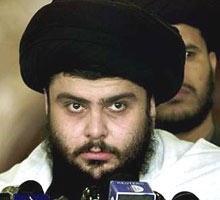
MOQTADA Sadr appears to have managed to cut a deal with the interim government in Iraq and pre-empted a US-backed Iraqi security forces' storming of the Imam Ali Mosque in Najaf that would have possibly led to his capture or death.
He has agreed to disarm his Mahdi Army militia and leave the city and also integrate his movement into Iraqi politics.
However, one could not but be sceptical about the strength of the commitments in the deal. The priorities and approaches of Sadr and the interim prime minister, Iyad Allawi, might have converged on the compromise to defuse the crisis in Najaf, but the two are fundamentally poles apart in their visions of the future of Iraq.
Allawi has no choice but to follow the US-drafted course for Iraq since the US military has Iraq in a stranglehold. His political future is tied with the US version of Iraq for in the interim at least. That course would not allow him any room to have someone like Sadr who could pounce at the right moment and scramble the scenario.
Sadr is not of the mold where he would hold his peace while Allawi gets ahead on the US-designed course. Definitely, at some point, sooner than later, the two would clash, even if Sadr were to enter the evolving mainstream Iraqi politics.
With the guerrilla war showing little sign of abating, Allawi would be hardpressed to meet the basic demands of the people of Iraqi in a satisfactory manner, whether for water, power, food, jobs and security. Given that the south of Iraq had not been given a fair share of attention for development during the Saddam Hussein reign, the situation in that region is all the more precarious for Allawi as he tries to restore normalcy to the country.
As such, apart from the wide gap in ideologies with Allawi, Sadr would also have to confront the interim prime minister with the daily life issues of his people; that is, if Sadr follows the traditions of politics. On both counts, the scene is the perfect reciple for trouble pitting the two. The only question is how long will it take for fresh blood to spill.
Friday, August 13, 2004
Spare us the exonerations
August 12 2004
Please spare us the exonerations
pv vivekanand
IT IS disgusting to read reports after reports about reports of the findings of the dozens of secret and public investigations conducted into the abuse of prisoners at the US-run Abu Ghraib prison and other detention facilities in post-war Iraq. Almost all the reports exonerate top political officials of the Bush administration and the Pentagon as well as the top brass in the US military while media reports are lavish with suggestions that only a "handful" of "rogue elements" and "undisciplined" soldiers and private contractors were behind the abuse.
But then, does it really matter to us who exactly in the American hierarchy was responsible for the worst kind of violations of human dignity in recent history?
It is a collective responsibility that should weigh down heavily on the American mind.
We do realise that investigating the abuses and identifying those directly responsible for the abuses is an American imperative. The legal process has to be followed the guilty should be punished; that is what the American sytem demands.
It is a more of an internal issue for the Americans.
For us in this part of the world, everyone, from the senior-most official, elected or otherwise, in the US down to the private American who treated Iraqi prisoners likes the worst animals on earth, is equally guilty of prejudice and hatred cultivated by the policies of successive American administrations.
Can the US administration wriggle out of the reality that dehumanising Arabs, particularly the Palestinians and Iraqis, through the mainstream media and project them as unworthy of being treated as human beings was a direct or indirect American policy objective? Will the American public would ever be told of this reality?
As such, reports of repeated exonerations of top political officials of the Bush administration makes us want to throw up.
Where does the buck stop?
Indeed, a line has been drawn between the officers who actually served in Iraq and those who pulled the strings from Washington.
Lieutenant-General Ricardo Sanchez, who was the top American military officer in Iraq at the time of the abuse, was quietly removed from the post months after reports of the abuse appeared in the media.
Sanchez as well as his boss, General John Abizaid, head of the US Central Command, have testified in the US Congress that they did not find out about the abuse until this year when a military policeman revealed the problem at the prison. However, other accounts have spoken of complaints of abuse being filed in the third quarter of last year.
The senior most officer to be suspended in this connection was Brigadier-General Janis Karpinski, who commanded the 800th Military Police Brigade in Iraq late last year. She has been issued a letter of reprimand and been suspended from her post. Seven other military police reservists are facing charges. All except one of them have pleaded innocent saying they were only following orders. Even the one who pleaded guilty says he had instructions to treat the prisoners that way.
If Karpinski is to be believed, then she is also innocent. She could not be expected to know what was going on in the corridors of the Abu Ghraib prison outside Baghdad except from reports filed by her juniors.
The latest US Army report also has cleared top US military officers in Iraq of abuse of prisoners at Abu Ghraib but implicates 20 or more intelligence troops in the scandal.
The report, according to Reuters, recommends disciplinary action such as administrative reduction in rank and loss of pay as well as further investigation that could lead to military trials.
It does not matter to us if US President George Bush pleads that he did not know what was going in the Abu Ghraib prison outside Baghdad; that he did not know his soldiers and "private experts in interrogation" were playing sadistic football with Iraqi prisoners, humiliating them to the lowest level that any human being would ever consider himself to be and torturing them and subjecting them to conditions where they longed for death.
Whoever they are, the torturers and tormentors did not happen to walk into Abu Gharaib on their own. They were brought there and unleashed on the Iraqis by the US government. Can Washington argue its way out of that responsibility?
It has been nearly five months since the news hit the headlines that an internal investigation has unearthed gross violations of human rights, dignity and self-respect at Abu Ghraib. Probably, had it not been for journalists like Seymour Hersh and others the world would not have known about it either until sometime later (let us respect the integrity and investigating skills of American journalists in general; someone or another might have unveiled the findings of the investigation sooner or later).
For sure, top officials in Washington knew about the abuses several months earlier since they should have but been informed about complaints being received before the investigation was launched.
Throughout this period, the administration only tried to keep it away from the world that there were credible reports about prisoner abuse in Iraq. It is surprising that they hoped to get away with it, expecting to keep everything under wraps under the rules of confidentiality of the US military.
As such, the pledges by Defence Secretary Donald Rumsfeld and other top officials that they were committed to thoroughly investigating the reports of abuse of prisoners in Iraq and Afghanistan sounded hollow and meaningless and seemed aimed only at public consumption. That is not to say that they would not investigate the cases, but that they are trying to divert attention from the fact that they had created the atmosphere that led to the abuses.
When the news of the abuses came out, everyone tried to pass the buck for some time and then the president and his defence secretary offered an "apology" but they did not know about the incidents until the investigation report was released.
It is the second part that we find insulting our intelligence, because it was precisely the indifference and contempt with which consecutive American administrations treated the Arabs that led to emboldening whoever abused Iraqi prisoners into thinking that it was permitted. Secondly, the administration knew well that such practices were common in Guantanamo Bay and it was no coincidence that one of the top commanders there was transferred to Iraq to introduce the same there.
A relevant question is: Would Bush or any other administration official would ever admit that they would not care how their military collects "information" that help the battle against Iraqi resistance? Would they really care that it came through torture of the worst degree?
We also know that Washington strategists hired Israeli "experts" at interrogating Palestinians and deployed them at Abu Ghraib. They were not sent there to hold the hands of the prisoners but to unleash a reign of terror among the detainees. Indeed, the Israeli experts would have loved doing it, if only because some of their own rules restrain them from exercising such sadism and brutality against Palestinian prisoners in Israeli jails. They had no such constraints in Iraq. They were free to do whatever they wished with the detainees with no questions asked.
American 'tradition'
In a broader context, it is an American tradition, as author and commentator Doug Stokes argues, to use whatever means to contain and destroy social forces considered inimical to US interests.
Stokes has described the reports prisoner abuse in Abu Ghraib as merely confirming "what has long been a legitimate tactic within US counter-insurgency warfare: the targeting and torture of civilians."
"This terror serves not only to break the will of those targeted but has a wider symbolic psychological function in that it dramatically raises the cost of dissent," he writes. "Whether it is was a 'war on communism' during the Cold War, or a 'war on terrorism' in the post-9/11 era, the targets and tactics have remained the same and the abuses at Abu Ghraib are the logical outcome of what the US has long been teaching both its own counter-insurgency specialists and those of allied nations."
He goes on to say: "The abuses committed at Abu Ghraib thus form part of a covert tradition within the history of US imperial policing and counter-insurgency warfare."
That might indeed be true when seen through an American point of view. However, for us here in the Middle East, the American and Israeli abuse of Iraqi prisoners has a sinister perspective: The victims were Arabs and Muslims.
Please spare us the exonerations
pv vivekanand
IT IS disgusting to read reports after reports about reports of the findings of the dozens of secret and public investigations conducted into the abuse of prisoners at the US-run Abu Ghraib prison and other detention facilities in post-war Iraq. Almost all the reports exonerate top political officials of the Bush administration and the Pentagon as well as the top brass in the US military while media reports are lavish with suggestions that only a "handful" of "rogue elements" and "undisciplined" soldiers and private contractors were behind the abuse.
But then, does it really matter to us who exactly in the American hierarchy was responsible for the worst kind of violations of human dignity in recent history?
It is a collective responsibility that should weigh down heavily on the American mind.
We do realise that investigating the abuses and identifying those directly responsible for the abuses is an American imperative. The legal process has to be followed the guilty should be punished; that is what the American sytem demands.
It is a more of an internal issue for the Americans.
For us in this part of the world, everyone, from the senior-most official, elected or otherwise, in the US down to the private American who treated Iraqi prisoners likes the worst animals on earth, is equally guilty of prejudice and hatred cultivated by the policies of successive American administrations.
Can the US administration wriggle out of the reality that dehumanising Arabs, particularly the Palestinians and Iraqis, through the mainstream media and project them as unworthy of being treated as human beings was a direct or indirect American policy objective? Will the American public would ever be told of this reality?
As such, reports of repeated exonerations of top political officials of the Bush administration makes us want to throw up.
Where does the buck stop?
Indeed, a line has been drawn between the officers who actually served in Iraq and those who pulled the strings from Washington.
Lieutenant-General Ricardo Sanchez, who was the top American military officer in Iraq at the time of the abuse, was quietly removed from the post months after reports of the abuse appeared in the media.
Sanchez as well as his boss, General John Abizaid, head of the US Central Command, have testified in the US Congress that they did not find out about the abuse until this year when a military policeman revealed the problem at the prison. However, other accounts have spoken of complaints of abuse being filed in the third quarter of last year.
The senior most officer to be suspended in this connection was Brigadier-General Janis Karpinski, who commanded the 800th Military Police Brigade in Iraq late last year. She has been issued a letter of reprimand and been suspended from her post. Seven other military police reservists are facing charges. All except one of them have pleaded innocent saying they were only following orders. Even the one who pleaded guilty says he had instructions to treat the prisoners that way.
If Karpinski is to be believed, then she is also innocent. She could not be expected to know what was going on in the corridors of the Abu Ghraib prison outside Baghdad except from reports filed by her juniors.
The latest US Army report also has cleared top US military officers in Iraq of abuse of prisoners at Abu Ghraib but implicates 20 or more intelligence troops in the scandal.
The report, according to Reuters, recommends disciplinary action such as administrative reduction in rank and loss of pay as well as further investigation that could lead to military trials.
It does not matter to us if US President George Bush pleads that he did not know what was going in the Abu Ghraib prison outside Baghdad; that he did not know his soldiers and "private experts in interrogation" were playing sadistic football with Iraqi prisoners, humiliating them to the lowest level that any human being would ever consider himself to be and torturing them and subjecting them to conditions where they longed for death.
Whoever they are, the torturers and tormentors did not happen to walk into Abu Gharaib on their own. They were brought there and unleashed on the Iraqis by the US government. Can Washington argue its way out of that responsibility?
It has been nearly five months since the news hit the headlines that an internal investigation has unearthed gross violations of human rights, dignity and self-respect at Abu Ghraib. Probably, had it not been for journalists like Seymour Hersh and others the world would not have known about it either until sometime later (let us respect the integrity and investigating skills of American journalists in general; someone or another might have unveiled the findings of the investigation sooner or later).
For sure, top officials in Washington knew about the abuses several months earlier since they should have but been informed about complaints being received before the investigation was launched.
Throughout this period, the administration only tried to keep it away from the world that there were credible reports about prisoner abuse in Iraq. It is surprising that they hoped to get away with it, expecting to keep everything under wraps under the rules of confidentiality of the US military.
As such, the pledges by Defence Secretary Donald Rumsfeld and other top officials that they were committed to thoroughly investigating the reports of abuse of prisoners in Iraq and Afghanistan sounded hollow and meaningless and seemed aimed only at public consumption. That is not to say that they would not investigate the cases, but that they are trying to divert attention from the fact that they had created the atmosphere that led to the abuses.
When the news of the abuses came out, everyone tried to pass the buck for some time and then the president and his defence secretary offered an "apology" but they did not know about the incidents until the investigation report was released.
It is the second part that we find insulting our intelligence, because it was precisely the indifference and contempt with which consecutive American administrations treated the Arabs that led to emboldening whoever abused Iraqi prisoners into thinking that it was permitted. Secondly, the administration knew well that such practices were common in Guantanamo Bay and it was no coincidence that one of the top commanders there was transferred to Iraq to introduce the same there.
A relevant question is: Would Bush or any other administration official would ever admit that they would not care how their military collects "information" that help the battle against Iraqi resistance? Would they really care that it came through torture of the worst degree?
We also know that Washington strategists hired Israeli "experts" at interrogating Palestinians and deployed them at Abu Ghraib. They were not sent there to hold the hands of the prisoners but to unleash a reign of terror among the detainees. Indeed, the Israeli experts would have loved doing it, if only because some of their own rules restrain them from exercising such sadism and brutality against Palestinian prisoners in Israeli jails. They had no such constraints in Iraq. They were free to do whatever they wished with the detainees with no questions asked.
American 'tradition'
In a broader context, it is an American tradition, as author and commentator Doug Stokes argues, to use whatever means to contain and destroy social forces considered inimical to US interests.
Stokes has described the reports prisoner abuse in Abu Ghraib as merely confirming "what has long been a legitimate tactic within US counter-insurgency warfare: the targeting and torture of civilians."
"This terror serves not only to break the will of those targeted but has a wider symbolic psychological function in that it dramatically raises the cost of dissent," he writes. "Whether it is was a 'war on communism' during the Cold War, or a 'war on terrorism' in the post-9/11 era, the targets and tactics have remained the same and the abuses at Abu Ghraib are the logical outcome of what the US has long been teaching both its own counter-insurgency specialists and those of allied nations."
He goes on to say: "The abuses committed at Abu Ghraib thus form part of a covert tradition within the history of US imperial policing and counter-insurgency warfare."
That might indeed be true when seen through an American point of view. However, for us here in the Middle East, the American and Israeli abuse of Iraqi prisoners has a sinister perspective: The victims were Arabs and Muslims.
Battle won, but war is lost

by pv vivekanand
THE US military's assault on Najaf with a view to dislodging Motqada Sadr and his militia from the holy city is definitely a make-or-break drive. The US military will win the battle for Najaf, but the victory will be another brick in the tomb of American hopes of winning the war in Iraq and another contribution to increasing anti-US sentiments in the Islamic world, particularly the 120 million Shiites.
Temporary deals might be worked out that could prolong the crisis in Najaf by holding back the climax of the assault, but the US would not be dissuaded from its objective — neutralising Sadr as a challenger to the US military's efforts to pacify Iraq and improve conditions for implementing the Washington-backed process to conduct elections in January to a government that would give legitimacy to the American role in the country.
American strategists are perfectly aware that Sadr's declarations that he would never bow to the US and is ready to fight until death as well as his exhortations to his Mahdi's Army militia to continue fighting after his death are strengthening the resolve of anti-US forces in Iraq. The less he is allowed to say the better, as seen from Washington.
Neutralising Sadr is a political as well as security imperative for the interim government. Iyad Allawi, the interim prime minister, has to show his people that he is strong and capable of overcoming all challenges and also send a tough warning to other militant groups by setting an example in Najaf.
However, a no-holds-barred assault against Najaf and a possible storming of the Imam Ali Mosque there — even if by Iraqi Muslim security personnel — would be like stirring an already troubled hornet's nest and further alienate the Shiites against the interim government.
Sadr loyalists have already warned if their leader is harmed — he was reported to have been wounded in the US assault on Friday — then they would turn to be suicide bombers against the US forces and allies. The warning should not be taken lightly since it signals a deadly turn of events for the US military in southern Iraq.
The demonstrations in Iraq and Iran on Friday against the US operations in Najaf are the forerunners of much worse Shiite repercussions against the US-led coalition forces and their allies in Iraq. The events in Najaf could lead to sparking an anti-US Shiite revolt in the south of the country along the lines of the rebellion in the so-called "Sunni triangle" encompassing areas near Baghdad and the Anbar province adjoining the border with Jordan and Syria.
The US also risks alienating Shiites beyond the immediate Iraq-Iran theatre, including those in countries like Pakistan and Lebanon.
The Shiites had largely stayed put in south of Iraq and refrained from militarily challenging the US role in the country for one year after the fall of Saddam Hussein in April 2003. Obviously, they were hoping to gain power by virtue of their numerical strength in the country.
But they rose up in protest when they saw that their "natural" role as the majority sect in the 25-million population Iraq was being sidelines by people they considered as too close to the US for comfort. Allawi is indeed a Shiite, so are several other members of the interim cabinet, but many Shiites in Iraq are not willing to grant Allawi and others the Shiite legitimacy that they need.
When the US handed over "sovereignty" to the interim government in late June, most Iraqis — Sunnis and Shiites — were willing to Allawi a chance to prove its independence and ability to take control and administer the country. However, the interim authority's decisions and actions since it took over have not been very popular.
The Shiites would like to have their own say as to who their representative should be in the government — and it need not be Moqtada Sadr. They believe that their right to have a dominating say in the affairs of the country was hijacked when the US handed over "sovereignty" to the interim government, whose members were chosen by Washington.
Sadr has also declared his boycott of the Iraqi national convention to be held this week to elect an interim assembly of 100 members who would guide the interim government to elections next year.
The Iranian link, if any, to the crisis in Najaf is unclear. US officials have suggested that Tehran is closely aligned with Sadr, but they have not come up with solid evidence to substantiate the theory.
At this juncture, the US military's attack on Najaf itself is seen as targeting Shiites rather than Sadr and his supporters per se. And the first to pay the price in terms of alienation with the Shiites will be the interim government, whose image as an independent authority would be further undermined.
Cracks have also started appearing in the interim government itself.
Vice-President Ibrahim Jaafari, head of the influential Dawa Party, has called for the departure of the US forces from Najaf whose very presence there was invited by Allawi after his ultimatum to Sadr's forces to quit the city went unheeded.
Also having an effect against the interim government is the fatwa issued by the Sunni Association of Muslim Clergymen that no Iraqi should co-operate with the US forces in killing other Muslims.
While the fatwa appeared to be oriented more towards the clashes in the Anbar province — Fallujah, and, to a limited extent, Ramadi — pitting local residents against the US military, it is deemed to have an impact on Shiites as well.
Grand Ayatollah Ali Al Sistani, the most reverred Shiite leader, is undergoing treatment in a London clinic for heart ailments. Some reports have suggested that the US-coalition, which includes the UK, had engineered his trip to London in order to clear the ground for an all-out assault against Sadr.
The demands laid down by a Sadr aide to end the crisis in Najaf are unlikely to be accepted by the US military. Sadr wants the departure of US forces from Najaf and handing over the city to the Marjayia, the Shiite religious authority; in return the Mahdi Army will also leave the city but will not be disarmed.
The militia is demanding recognition as an ideological movement and that members should allowed to carry weapons for self-defence, with an option to turn itself to be a political party. These are the minimum demands. Beyond them, Sadr wants all his "followers to gather under a legitimate constitution written by a free, elected government."
Giving in to the demands would mean a serious setback to the American resolve against militants in Iraq and questions raised over the credibility and legitimacy of the interim government. That is something the US strategists or the interim government could ill-afford. For them, Sadr has to be removed from the scene and his armed followers should never again be allowed to pose a challenge to the US domination of the country.
Therefore, compromise deals, if any is made, would only be stop-gap measures that would only slightly delay a US-led assault to end the crisis once and for all. What happens thereafter is clear: A low-intensity but sustained war of attrition between Shiites and the US-led coalition and their Iraqi allies that could wreck the Washington's vision of elections and transition of power to a "democratically elected government."
Tuesday, August 10, 2004
Golan - it's water not security
August 10 2004
It's water, not security
pv vivekanand
An Israeli general's statement that his country does not need to keep Syria's Golan Heights under occupation should be seen strictly in the military context. It does not mean that Israel is ready to return the Golan Heights to Syria as the basis for a peace agreement or it has any intention to do so. All it might mean is that the Israeli military says it is capable of "defending" Israel without having military forces present on the Golan Heights.
Indeed, it signals a shift from consistent Israeli contention that it was prompted to seize the Golan Heights in 1967 because the Syrians were using the Heights to shoot down at Israeli farmers and that the Jewish state needed to retain the Heights in order to ensure its security. However, it does not seem to have a political context at this jucture.
Given that Syria possesses missiles capable of hitting almost everywhere in Israel, the "security" claim has always sounded hollow. Therefore, the latest statement is only an affirmation that retaining the Golan Heights is not central to Israeli security.
That the hawkish prime minister of Israel, Ariel Sharon, is holding back any comment on the remark by Chief of Staff General Moshe Yaalon indicates that Sharon would like the idea to be floated to drag out a Syrian response if only for theoretical purposes. Sure enough, Syria has rebuffed the idea by insisting on definite Israeli action on the ground with a commitment to withdrawing from the Golan.
Sharon, a military general who has also served as Israel's minister for water, could not but be acutely aware of the importance of the Golan Heights for his country's paranoia and preoccupation with securing water sources.
Sharon should be aware that it is as much as a military strategy as a need to ensure its main source of water that is behind Israel's occupation of the Golan Heights and its refusal to give it up in return for peace with Syria.
The Golan is the source for more than 55 per cent of Israel's fresh water needs. Given the scarcity of water in the region and its paranoia of being forced to depend on Syria, Israel would never give up the Golan. At best, it might be willing to make a face-saving compromise by returning part of the Golan and would never agree to return the whole of the strategic Heights, which overlook the See of Galilee in northern Israel (it also known as Lake Tiberias and Israelis call it Lake of Kinneret. Lake Tiberias is best known for its association with the lives of Jesus Christ and his disciples. In the Bible the lake is referred to as the Sea of Chinnereth or Chinneroth, Gennesar, Lake of Gennesaret, Sea of Galilee, and Sea of Tiberias, a name that has survived in the modern Arabic Bahrat Tabariya. It is 20 kilometres long and 12 kilometres wide and lies around 220 metres below sea level).
Securing water sources has been an Israeli priority since its founding in 1948 and it remains a preoccupation today; the per capita consumption of water in Israel is eight times that of the Palestinians living in the occupied West Bank, which accounts for 18 per cent of Israel's needs of drinking water.
In 1950, the then Israeli prime minister, Ben Gurion, declared that Jews were fighting a battle for water and that the Jewish existence in Palestine was contingent on the outcome of such battle.
Water from Syrian upstream sources flown down the Golan and is accumulated at the Sea of Galilee before flowing further to the River Jordan and onto the Dead Sea, the lowest point on earth.
Israel, which occupied the Golan in the 1967 war and unilaterally annexed it in 1981, usually argues that since the Golan overlooks northern Israeli towns a withdrawal from the Heights would leave northern Israeli towns vulnerable to Syrian missile and infantry attacks.
In what was a departure from that assertion, Israeli Chief of Staff Moshe Yaalon said in an interview published on Friday there was no military reason why Israel could not withdraw to its pre-1967 war border with Syria.
Yaalon's comments was a departure from the military's traditional view that Israel needs at least part of the plateau as a "security buffer."
Yaalon told the Israeli daily Yediot Ahronot: "If you ask me, theoretically, if we can reach an agreement with Syria ... my answer is that from a military standpoint it is possible to reach an agreement by giving up the Golan Heights.
"The army is able to defend any border. This is correct for any political decision that is taken in Israel," he said.
Yaalon warned that Syria still represents a threat to Israel's "security" and that the two counties could once again find themselves engaged in a war.
"I can't ignore the scenario in which an escalation on the Lebanese front leads to a confrontation between the two armies," he said.
Yaalon noted that Syria has "missiles that put all of Israel in range and chemical capabilities."
Sharon has consistently opposed a withdrawal from the Syrian plateau. Sharon's predecessor, Ehud Barak, offered to withdraw from parts of the heights in 2000, but insisted on retaining some of the territory and American guarantees.
Syria wants action
Syria responded to Yaalon on Friday saying that it will not take seriously Israeli offers to pull out of the Golan Heights unless they are backed by moves on the ground or an open commitment to withdraw.
Ahmad Haj Ali, advisor to the Syrian information minister, said:
"We don't give such statements any weight unless they are associated with a serious move (towards peace) and with international guarantees. Whoever is willing to make peace should return the land to its owners and withdraw immediately or declare that openly and clearly."
Haj Ali said he believed Yaalon's statement was designed to "show Israel was the party seeking peace in order to look good in the upcoming American elections."
Syrian-Israeli peace talks were launched in 1991 in Madrid, but they collapsed in 2000, with Syrians insisting on a complete withdrawal from the Golan, and Israel seeking border adjustments near the Sea of Galilee,.
Now, Israel says Syria must first end its support for Hizbollah guerrillas in Lebanon and Palestinian groups it hosts in Syria itself. Syria rejects the demands saying it is supporting the legitimate right of people to resist foreign occupation.
In the Syrian view, Israel will not to relinquish the Golan, where some 20,000 Jewish settlers live, because it considers the Heights as a part of Israeli land. Furthermore, Israel believes its present borders should be recognised as such in any peace agreement.
It will reject any plan which includes any relinquishment of any part of Israel's land as opposing the right of the Jews in such land and jeopardising Israel's security and existence. That is why Israel will not withdraw from the Golan under all circumstances and will not demolish any settlement on the Heights, says the Syrian National Information Centre.
Former Israeli prime minister Benjamin Netanyahu, who represents a majority in the Likud party of Sharon and seen more hawkish than the prime minister, has said: "We are ready to continue negotiating with the Syrians on the basis that they are aware that they won't get back the Golan and that we, from our side, won't give up a total peace."
However, the Syrians have been insisting that the peace negotiations be resumed from the point they broke off while Barak was in power where he had promised to withdraw from virtually all of the Golan Heights except a one-square-kilometre area on a condition that the US provides certain guarantees.
At this point in time, it seems unlikely that Sharon finds himself under any compulsion to make any overture to Syria. He is too busy securing his own position while advancing his plan for "unilateral disengagement" from the Gaza Strip.
It's water, not security
pv vivekanand
An Israeli general's statement that his country does not need to keep Syria's Golan Heights under occupation should be seen strictly in the military context. It does not mean that Israel is ready to return the Golan Heights to Syria as the basis for a peace agreement or it has any intention to do so. All it might mean is that the Israeli military says it is capable of "defending" Israel without having military forces present on the Golan Heights.
Indeed, it signals a shift from consistent Israeli contention that it was prompted to seize the Golan Heights in 1967 because the Syrians were using the Heights to shoot down at Israeli farmers and that the Jewish state needed to retain the Heights in order to ensure its security. However, it does not seem to have a political context at this jucture.
Given that Syria possesses missiles capable of hitting almost everywhere in Israel, the "security" claim has always sounded hollow. Therefore, the latest statement is only an affirmation that retaining the Golan Heights is not central to Israeli security.
That the hawkish prime minister of Israel, Ariel Sharon, is holding back any comment on the remark by Chief of Staff General Moshe Yaalon indicates that Sharon would like the idea to be floated to drag out a Syrian response if only for theoretical purposes. Sure enough, Syria has rebuffed the idea by insisting on definite Israeli action on the ground with a commitment to withdrawing from the Golan.
Sharon, a military general who has also served as Israel's minister for water, could not but be acutely aware of the importance of the Golan Heights for his country's paranoia and preoccupation with securing water sources.
Sharon should be aware that it is as much as a military strategy as a need to ensure its main source of water that is behind Israel's occupation of the Golan Heights and its refusal to give it up in return for peace with Syria.
The Golan is the source for more than 55 per cent of Israel's fresh water needs. Given the scarcity of water in the region and its paranoia of being forced to depend on Syria, Israel would never give up the Golan. At best, it might be willing to make a face-saving compromise by returning part of the Golan and would never agree to return the whole of the strategic Heights, which overlook the See of Galilee in northern Israel (it also known as Lake Tiberias and Israelis call it Lake of Kinneret. Lake Tiberias is best known for its association with the lives of Jesus Christ and his disciples. In the Bible the lake is referred to as the Sea of Chinnereth or Chinneroth, Gennesar, Lake of Gennesaret, Sea of Galilee, and Sea of Tiberias, a name that has survived in the modern Arabic Bahrat Tabariya. It is 20 kilometres long and 12 kilometres wide and lies around 220 metres below sea level).
Securing water sources has been an Israeli priority since its founding in 1948 and it remains a preoccupation today; the per capita consumption of water in Israel is eight times that of the Palestinians living in the occupied West Bank, which accounts for 18 per cent of Israel's needs of drinking water.
In 1950, the then Israeli prime minister, Ben Gurion, declared that Jews were fighting a battle for water and that the Jewish existence in Palestine was contingent on the outcome of such battle.
Water from Syrian upstream sources flown down the Golan and is accumulated at the Sea of Galilee before flowing further to the River Jordan and onto the Dead Sea, the lowest point on earth.
Israel, which occupied the Golan in the 1967 war and unilaterally annexed it in 1981, usually argues that since the Golan overlooks northern Israeli towns a withdrawal from the Heights would leave northern Israeli towns vulnerable to Syrian missile and infantry attacks.
In what was a departure from that assertion, Israeli Chief of Staff Moshe Yaalon said in an interview published on Friday there was no military reason why Israel could not withdraw to its pre-1967 war border with Syria.
Yaalon's comments was a departure from the military's traditional view that Israel needs at least part of the plateau as a "security buffer."
Yaalon told the Israeli daily Yediot Ahronot: "If you ask me, theoretically, if we can reach an agreement with Syria ... my answer is that from a military standpoint it is possible to reach an agreement by giving up the Golan Heights.
"The army is able to defend any border. This is correct for any political decision that is taken in Israel," he said.
Yaalon warned that Syria still represents a threat to Israel's "security" and that the two counties could once again find themselves engaged in a war.
"I can't ignore the scenario in which an escalation on the Lebanese front leads to a confrontation between the two armies," he said.
Yaalon noted that Syria has "missiles that put all of Israel in range and chemical capabilities."
Sharon has consistently opposed a withdrawal from the Syrian plateau. Sharon's predecessor, Ehud Barak, offered to withdraw from parts of the heights in 2000, but insisted on retaining some of the territory and American guarantees.
Syria wants action
Syria responded to Yaalon on Friday saying that it will not take seriously Israeli offers to pull out of the Golan Heights unless they are backed by moves on the ground or an open commitment to withdraw.
Ahmad Haj Ali, advisor to the Syrian information minister, said:
"We don't give such statements any weight unless they are associated with a serious move (towards peace) and with international guarantees. Whoever is willing to make peace should return the land to its owners and withdraw immediately or declare that openly and clearly."
Haj Ali said he believed Yaalon's statement was designed to "show Israel was the party seeking peace in order to look good in the upcoming American elections."
Syrian-Israeli peace talks were launched in 1991 in Madrid, but they collapsed in 2000, with Syrians insisting on a complete withdrawal from the Golan, and Israel seeking border adjustments near the Sea of Galilee,.
Now, Israel says Syria must first end its support for Hizbollah guerrillas in Lebanon and Palestinian groups it hosts in Syria itself. Syria rejects the demands saying it is supporting the legitimate right of people to resist foreign occupation.
In the Syrian view, Israel will not to relinquish the Golan, where some 20,000 Jewish settlers live, because it considers the Heights as a part of Israeli land. Furthermore, Israel believes its present borders should be recognised as such in any peace agreement.
It will reject any plan which includes any relinquishment of any part of Israel's land as opposing the right of the Jews in such land and jeopardising Israel's security and existence. That is why Israel will not withdraw from the Golan under all circumstances and will not demolish any settlement on the Heights, says the Syrian National Information Centre.
Former Israeli prime minister Benjamin Netanyahu, who represents a majority in the Likud party of Sharon and seen more hawkish than the prime minister, has said: "We are ready to continue negotiating with the Syrians on the basis that they are aware that they won't get back the Golan and that we, from our side, won't give up a total peace."
However, the Syrians have been insisting that the peace negotiations be resumed from the point they broke off while Barak was in power where he had promised to withdraw from virtually all of the Golan Heights except a one-square-kilometre area on a condition that the US provides certain guarantees.
At this point in time, it seems unlikely that Sharon finds himself under any compulsion to make any overture to Syria. He is too busy securing his own position while advancing his plan for "unilateral disengagement" from the Gaza Strip.
Friday, August 06, 2004
9/11 and Israeli insider trading
rican Investigators have established that in the
two weeks before the Sept.11, 2001 attacks in New York
and Washington, a group of Israeli speculators did a
particular manoeuvring in the stock market by selling
"short" stocks of 38 companies that were expected to
lose in value as a result of the attacks. They made
tens of millions of dollars through the deal, which
clearly indicated that they had prior knowledge of the
attacks.
Selling "short" means passing the shares of a friendly
buyer and then buy them back when the price falls. No
money actually hands except in books and both seller
and buyer are winners. If such deals take place just
ahead of events that have economic impact in the
market, then they automatically become suspect and are
treated as having carried out by people who had prior
knowledge of such events.
The deals were made between Aug.26 and Sept.10, 2001,
and according to
the American Securities and Exchange Commission these
speculators operated out of the Toronto, Canada and
Frankfurt, Germany stock exchanges.
The deals were made despite strict monitoring by the
Central Intelligence Agency (CIA), which uses special
software to keep a watch on stock market trading with
a view to check for possible warning sign of a
terrorist attack or suspicious economic behaviour.
The CIA immediately suspected that the Aug.26-Sept.10
deals had something to do with prior knowledge of the
attacks. The agency requested the Financial Services
Authority in London to investigate the suspicious
deals, with the hope that trail might lead to the
terrorists.
However, what the agency found was the trail led to a
group of Israeli speculators operating out of Canada.
And then it emerged that the deals were also made
through the stock markets of Japan, Germany, the
United Kingdom, France, Luxembourg, Hong Kong,
Switzerland and Spain, and the same Israeli group were
behind those deals.
According to Adam Hamilton of Zeal LLC, a North
Dakota-based private consulting company that
publishes research on markets worldwide, as much as
$22 million were made as profit by the speculators.
London broker and analyst Richard Crossley has said
that that someone was selling shares in unusually
large quantities beginning three weeks before the
Sept.11 attacks and he had decided that this as
evidence that someone had insider foreknowledge of
the attacks.
According to the the Interdisciplinary Center, a
counter-terrorism think tank involving former
intelligence officers, "insider trading" — another
name for "short selling" — made nearly $16 million
profit by short selling shares in American and United
Airlines, the two airlines that suffered hijacking,
and the investment firm of Morgan Stanley, which
occupied 22 floors of the WTC.
The CIA failed to link any of the suspicious
transactions with Osama Bin Laden or anyone remotedly
connected with it, and when the Israeli connection
became known, there was a total blackout of any
reports what the agency had found. At that time, many
suspected that the trail led to American firms or
intelligence agencies.
The companies whose stocks were sold "short" include:
he list includes stocks of American Airways, United
Air, Continental, Northwest, Southwest and US Airways
airlines, as well as Martin, Boeing, Lockheed Martin
Corp., AIG, American Express Corp, American
International Group, AMR Corporation, Axa SA, Bank of
America Corp, Bank of New York Corp, Bank One Corp,
Cigna Group, CNA Financial, Carnival Corp, Chubb
Group, John Hancock Financial Services, Hercules Inc,
L-3 Communications Holdings, Inc., LTV Corporation,
Marsh & McLennan Cos. Inc., MetLife, Progressive
Corp., General Motors, Raytheon, W.R. Grace, Royal
Caribbean Cruises, Ltd., Lone Star Technologies,
American Express, the Citigroup Inc. ,Royal & Sun
Alliance, Lehman Brothers Holdings, Inc., Vornado
Reality Trust, Morgan Stanley, Dean Witter & Co., XL
Capital Ltd., and Bear Stearns. The names of these
companies were released by the American Securities and
Exchange Commission, which, at that time, was seeking
information on whoever had sold short their shares and
repurchased them after the Sept.11 attacks.
All these companies suffered directly or indirectly as
a result of the attacks and all their shares fell
steeply after the attacks. The four planes used in the
attacks in New York and Washington belonged to
American Airways and United. On Sept.,6, 2001, alone
2,075 sell-short deals were made on shares of
United Airlines and on Sept. 10, the day before the
attacks, 2,282 sell-short deals were recorded for
American Airlines. The profit from the deals were
estimated at b etween $2 million and $4 million.
What is more interesting is that most of the short
selling deals were handled primarily by Deutsche
Bank-A.B.Brown. Until 1998, the bank was chaired by A.
B. Krongard, who later became executive director of
the CIA.
Also interesting is that despite conflicting reports
in the beginning, it was reported by the New York
Times on Sept.22, 11 days after the attacks, that only
three Israelis were confirmed as dead: two on the
hijacked planes and another who had been visiting the
World Trade Centre towers on business.
The FBI and CIA say that they are continuing
investigations, but other sources say the
investigations have been completed some months ago,
and the findings were being held back just as key
parts of the congressional investigation into the 9/11
attacks are being kept away from the public eye.
After all, that the stranglehold that Israel has on
Washington.
two weeks before the Sept.11, 2001 attacks in New York
and Washington, a group of Israeli speculators did a
particular manoeuvring in the stock market by selling
"short" stocks of 38 companies that were expected to
lose in value as a result of the attacks. They made
tens of millions of dollars through the deal, which
clearly indicated that they had prior knowledge of the
attacks.
Selling "short" means passing the shares of a friendly
buyer and then buy them back when the price falls. No
money actually hands except in books and both seller
and buyer are winners. If such deals take place just
ahead of events that have economic impact in the
market, then they automatically become suspect and are
treated as having carried out by people who had prior
knowledge of such events.
The deals were made between Aug.26 and Sept.10, 2001,
and according to
the American Securities and Exchange Commission these
speculators operated out of the Toronto, Canada and
Frankfurt, Germany stock exchanges.
The deals were made despite strict monitoring by the
Central Intelligence Agency (CIA), which uses special
software to keep a watch on stock market trading with
a view to check for possible warning sign of a
terrorist attack or suspicious economic behaviour.
The CIA immediately suspected that the Aug.26-Sept.10
deals had something to do with prior knowledge of the
attacks. The agency requested the Financial Services
Authority in London to investigate the suspicious
deals, with the hope that trail might lead to the
terrorists.
However, what the agency found was the trail led to a
group of Israeli speculators operating out of Canada.
And then it emerged that the deals were also made
through the stock markets of Japan, Germany, the
United Kingdom, France, Luxembourg, Hong Kong,
Switzerland and Spain, and the same Israeli group were
behind those deals.
According to Adam Hamilton of Zeal LLC, a North
Dakota-based private consulting company that
publishes research on markets worldwide, as much as
$22 million were made as profit by the speculators.
London broker and analyst Richard Crossley has said
that that someone was selling shares in unusually
large quantities beginning three weeks before the
Sept.11 attacks and he had decided that this as
evidence that someone had insider foreknowledge of
the attacks.
According to the the Interdisciplinary Center, a
counter-terrorism think tank involving former
intelligence officers, "insider trading" — another
name for "short selling" — made nearly $16 million
profit by short selling shares in American and United
Airlines, the two airlines that suffered hijacking,
and the investment firm of Morgan Stanley, which
occupied 22 floors of the WTC.
The CIA failed to link any of the suspicious
transactions with Osama Bin Laden or anyone remotedly
connected with it, and when the Israeli connection
became known, there was a total blackout of any
reports what the agency had found. At that time, many
suspected that the trail led to American firms or
intelligence agencies.
The companies whose stocks were sold "short" include:
he list includes stocks of American Airways, United
Air, Continental, Northwest, Southwest and US Airways
airlines, as well as Martin, Boeing, Lockheed Martin
Corp., AIG, American Express Corp, American
International Group, AMR Corporation, Axa SA, Bank of
America Corp, Bank of New York Corp, Bank One Corp,
Cigna Group, CNA Financial, Carnival Corp, Chubb
Group, John Hancock Financial Services, Hercules Inc,
L-3 Communications Holdings, Inc., LTV Corporation,
Marsh & McLennan Cos. Inc., MetLife, Progressive
Corp., General Motors, Raytheon, W.R. Grace, Royal
Caribbean Cruises, Ltd., Lone Star Technologies,
American Express, the Citigroup Inc. ,Royal & Sun
Alliance, Lehman Brothers Holdings, Inc., Vornado
Reality Trust, Morgan Stanley, Dean Witter & Co., XL
Capital Ltd., and Bear Stearns. The names of these
companies were released by the American Securities and
Exchange Commission, which, at that time, was seeking
information on whoever had sold short their shares and
repurchased them after the Sept.11 attacks.
All these companies suffered directly or indirectly as
a result of the attacks and all their shares fell
steeply after the attacks. The four planes used in the
attacks in New York and Washington belonged to
American Airways and United. On Sept.,6, 2001, alone
2,075 sell-short deals were made on shares of
United Airlines and on Sept. 10, the day before the
attacks, 2,282 sell-short deals were recorded for
American Airlines. The profit from the deals were
estimated at b etween $2 million and $4 million.
What is more interesting is that most of the short
selling deals were handled primarily by Deutsche
Bank-A.B.Brown. Until 1998, the bank was chaired by A.
B. Krongard, who later became executive director of
the CIA.
Also interesting is that despite conflicting reports
in the beginning, it was reported by the New York
Times on Sept.22, 11 days after the attacks, that only
three Israelis were confirmed as dead: two on the
hijacked planes and another who had been visiting the
World Trade Centre towers on business.
The FBI and CIA say that they are continuing
investigations, but other sources say the
investigations have been completed some months ago,
and the findings were being held back just as key
parts of the congressional investigation into the 9/11
attacks are being kept away from the public eye.
After all, that the stranglehold that Israel has on
Washington.
Sunday, July 25, 2004
Iran linked to 9/11?
July 25 2004
Iran linked to 9/11?
BY PV VIVEKANAND
The US has set Iran in its gunsights for "regime change" and Tehran would be hard pressed escape the trap. That is what has emerged from the US independent commission's finding that Iran had allowed eight to 10 of the Sept.11 suicide hijackers to pass through its territory months before the actual assaults and made sure their passports were not stamped with any record of the transit.
American pundits on both sides of the fence — those who opposed and favoured the war on Iraq — are now arguing that the US targeted the wrong country for regime change since the report indicates that Tehran was closer to Al Qaeda than Baghdad.
According to the commission, intelligence findings show that the Iranian government had instructed its border posts not to stamp the passports of Al Qaeda members from Saudi Arabia who were passing through Iran after training at Osama Bin Laden's camps in Afghanistan.
Al Qaeda operatives had freedom to cross between the two countries without any hindrance, the report asserts.
If the hijackers had Iranian entry stamp on passport they would have been subjected to strict questioning at any port of entry to the US and probably turned away.
The commission said that Osama Bin Laden's "representatives and Iranian officials had discussed putting aside Shiite-Sunni divisions to co-operate against the common enemy" and that a small group of A Qaeda members "subsequently travelled to Iran and Hizbollah camps in Lebanon for training in explosives, intelligence and security."
Iran has not denied the possibility that the suicide skyjackers passed through its territory and has cited in its defence the commission's finding that there was no evidence that Tehran was a party to the Sept.11 assaults or had known about them in advance.
Tehran has also rejected as unfounded American charges that it is sheltering Al Qaeda and Taliban fugitives who fled Afghanistan when the US invaded that country in late 2001 and that they include eight prominent Al Qaeda and Taliban figures remain in Iran, including Osama Bin Laden's son Saad and Saif Al Adel, once Al Qaeda's security chief.
They are supposedly kept under "protective custody" and it is thought that Iran might use them as pawns in dealings with the US.
The next scenario is predictable: US intelligence agencies coming up with evidence suggesting that Iran did know of Al Qaeda plans and was working in cahoots with Osama Bin Laden's group. It would take some time, but it is definitely coming.
There is already a move in Congress to produce legislation backing “regime change” in Iran.
US President George W. Bush, who labelled Iran part of an "exis of evil" along with Iraq and North Korea, has vowed that he is committed to regime change in Tehran would orchestrate it if he is re-elected in November. That is a very calculated statement. One could expect more "revelations" of the purported Iranian-Qaeda links in the months in the run-up to the first Tuesday of November when the Americans go to the polls but little action on the ground until then except stepped up pressure on Tehran.
That is what Bush meant when he said last week: "We will continue to look and see if the Iranians were involved (in the Sept.11 attacks)… As to direct connections with Sept. 11, we’re digging into the facts to determine if there was one.”
Thorn on the side
Following the ouster of Saddam Hussein, the next thorn on the American and Israeli sides is indeed Iran, whose theocratic leadership refuses to accept American domination of the region and continues to pose a hurdle to Washington's drive for absolutely unchallenged supremacy.
Israeli Prime Minister Ariel Sharon and his neo-conservative allies in Washington have been calling for "regime change" in Iran after Iraq.
Israel, which says it fears Iran is developing nuclear weapons that could be used against the Jewish state, is no doubt planning how to "take out" Iran's nuclear facilities. One of more Israeli submarines equipped with long-range missiles capable of hitting Iran's nuclear plants on the Gulf coast as well as deep inside the country are already patrolling the waters of the Arabian Sea.
But simply destroying Iran's nuclear facilities would not be enough for the US to remove the challenge it faces from Tehran. It needs to replace the theocrats in power with an "American-friendly" regime like the interim government it has installed in Baghdad.
The new regime in Tehran, under the American plans, will allow the US military to set up bases in Iran, abandon all ambitions to acquire nuclear weapons, reform its Islam, recognise Israel and will agree to be a US-Israeli dictated solution to the Middle East conflict.
However, a military approach along the lines of the Iraq invasion is not in the cards. After all, Iran is five times larger than Iraq and has 65 million people compared with 25 million Iraqis.
The Bush administration has already set the ground for the best option: Create internal troubles for the regime, build them up and turn them into an uprising against the government. Simultaneously, the US could intervene militarily to support the internal dissidents and finish the job of removing the regime from power.
Obviously, Washington strategists are betting that Iranian youth and students are discontented with the regime, which gives Muslim clerics too much influence over their lives, and the right assurances to them that the US is behind them in their drive to get rid of the mullahs would convince them to stage an uprising.
Towards this end, a US-based group of Iranians, including the son of the toppled Shah Pehlavi, has launched radio and television broadcasts aimed to incite the Iranians against the regime and American and allied agents are said to have penetrate Iranian groups inside the country.
Washington has also enlisted the help of Hossein Khomeini, grandson of the late Iranian patriarch, Ayatollah Ruhollah Khomeini.
Hossein Khomeini, who smuggled himself into Iraq and then visited the US without official approval before returning home last year, openly said he would favour an American military invasion of his country aimed at changing the clerical regime. He is said to have been placed under tight restrictions at home after his return home.
Hard-liners in the Bush camp who orchestrated the war against Iraq are sure to seize upon the Sept.11 commission's report and further strengthen the case of regime change for Iran In any event, Iran has emerged as a key behind-the-scene player in the invasion of Iraq. It is believed to have played a key role in creating "evidence" of weapons of mass destruction and fed it to anti-Saddam Ahmed Chalabi, who in turn furnished it to US intelligence agencies as well as the New York Times to build the case for war against Iraq.
(Chalabi is also accused of spying for Iran and tipping them off that US intelligence agencies were listening in to telephone conversations of Iranian leaders and notable others. That is deemed to have dealt a serious blow to American intelligence gathering on Iran).
'Natural course'
Since the US set the Taliban and Al Qaeda in its military sights following the Sept.11 attacks and fingered Iraq immediately after invading Afghanistan., it was clear that Iran and Syria were also listed for "regime change" although not necessarily in that order.
It is no coincidence that the next two US targets in the Middle East, Syria and Iran, are also among the most vocal against Israel just as Iraq under Saddam was. It is not simply a matter of convenience for the US that fundamental changes are made in these countries to remove the challenge to Israel if not to better suit the interests of Washington's sole "strategic ally" in the Middle East; it is indeed a policy objective just as the ouster of Saddam was.
Washington flirted with Syria in the early 90s because it suited US interests to do so but now Damascus has become more of a liability than an asset only because it insists on its rights and represents the toughest of all Arab parties on whom Israel wants to impose its version of peace.
Similarly, the US hoped it could do business with Iran when "moderate" Mohammed Khatami was elected president in 1997. However, those hopes failed to materialise in view of the "hard-line" religious establishment's grip on power on a parallel track with that of the government but with overriding authority.
Now that Khatami would soon step down after serving two terms, the US has little hopes that another "moderate" might take his place, and hence the recent posture that Washington had "given up" on Khatami.
Under the American view, the religious establishment's constitutional authority is too deep-rooted to be pried away through conventional political means adopted by political forces within the country. Again, in the US eyes, a "regime change" aiming at destroying the religious leaders' power is the order of the day in Iran.
Iran's support for Lebanon's Hizbollah and Palestinian groups is a constant source of concern for Israel, and, by extension, the US. Further compounding the concern are the advances that Iran has reportedly made in developing long-range missiles which could hit Israel, its acquisition of two Russian submarines and the ongoing construction of a nuclear power plant on the Gulf coast and the existence of two other nuclear facilities inland.
Bush's options
The revelations of the alleged Tehran-Qaeda collaboration places the Bush administration in a fresh bind. The link is far more firm than the discredited American claim that a senior Iraqi diplomat had met the leader of the Sept.11 suicide hijackers in Europe a few months before the air assaults in New York and Washington.
In recent months, the Washington strategists appeared to have set the Iranian file aside, focusing instead on ensuring that Bush wins re-election in November. However, they ensured that Tehran remained under international pressure by citing its alleged quest to develop nuclear weapons.
Furthermore, the Bush administration would not undertake another military adventure at this juncture, given the worsening crisis in post-Saddam Iraq and the growing belief among Americans that they were misled by their president and his aides into accepting military action against that country.
Obviously the purported Iran-Qaeda links would be sued to tighten the case against Iran — and also somehow dragging in Syria — but stopping short of any action that would have a negative impact on his already sagging prospects for re-election. Action will come only if the American people find him fit for another four years at 1600 Pennsylvania Avenue, but what that would be is anyone's guess.
Iran linked to 9/11?
BY PV VIVEKANAND
The US has set Iran in its gunsights for "regime change" and Tehran would be hard pressed escape the trap. That is what has emerged from the US independent commission's finding that Iran had allowed eight to 10 of the Sept.11 suicide hijackers to pass through its territory months before the actual assaults and made sure their passports were not stamped with any record of the transit.
American pundits on both sides of the fence — those who opposed and favoured the war on Iraq — are now arguing that the US targeted the wrong country for regime change since the report indicates that Tehran was closer to Al Qaeda than Baghdad.
According to the commission, intelligence findings show that the Iranian government had instructed its border posts not to stamp the passports of Al Qaeda members from Saudi Arabia who were passing through Iran after training at Osama Bin Laden's camps in Afghanistan.
Al Qaeda operatives had freedom to cross between the two countries without any hindrance, the report asserts.
If the hijackers had Iranian entry stamp on passport they would have been subjected to strict questioning at any port of entry to the US and probably turned away.
The commission said that Osama Bin Laden's "representatives and Iranian officials had discussed putting aside Shiite-Sunni divisions to co-operate against the common enemy" and that a small group of A Qaeda members "subsequently travelled to Iran and Hizbollah camps in Lebanon for training in explosives, intelligence and security."
Iran has not denied the possibility that the suicide skyjackers passed through its territory and has cited in its defence the commission's finding that there was no evidence that Tehran was a party to the Sept.11 assaults or had known about them in advance.
Tehran has also rejected as unfounded American charges that it is sheltering Al Qaeda and Taliban fugitives who fled Afghanistan when the US invaded that country in late 2001 and that they include eight prominent Al Qaeda and Taliban figures remain in Iran, including Osama Bin Laden's son Saad and Saif Al Adel, once Al Qaeda's security chief.
They are supposedly kept under "protective custody" and it is thought that Iran might use them as pawns in dealings with the US.
The next scenario is predictable: US intelligence agencies coming up with evidence suggesting that Iran did know of Al Qaeda plans and was working in cahoots with Osama Bin Laden's group. It would take some time, but it is definitely coming.
There is already a move in Congress to produce legislation backing “regime change” in Iran.
US President George W. Bush, who labelled Iran part of an "exis of evil" along with Iraq and North Korea, has vowed that he is committed to regime change in Tehran would orchestrate it if he is re-elected in November. That is a very calculated statement. One could expect more "revelations" of the purported Iranian-Qaeda links in the months in the run-up to the first Tuesday of November when the Americans go to the polls but little action on the ground until then except stepped up pressure on Tehran.
That is what Bush meant when he said last week: "We will continue to look and see if the Iranians were involved (in the Sept.11 attacks)… As to direct connections with Sept. 11, we’re digging into the facts to determine if there was one.”
Thorn on the side
Following the ouster of Saddam Hussein, the next thorn on the American and Israeli sides is indeed Iran, whose theocratic leadership refuses to accept American domination of the region and continues to pose a hurdle to Washington's drive for absolutely unchallenged supremacy.
Israeli Prime Minister Ariel Sharon and his neo-conservative allies in Washington have been calling for "regime change" in Iran after Iraq.
Israel, which says it fears Iran is developing nuclear weapons that could be used against the Jewish state, is no doubt planning how to "take out" Iran's nuclear facilities. One of more Israeli submarines equipped with long-range missiles capable of hitting Iran's nuclear plants on the Gulf coast as well as deep inside the country are already patrolling the waters of the Arabian Sea.
But simply destroying Iran's nuclear facilities would not be enough for the US to remove the challenge it faces from Tehran. It needs to replace the theocrats in power with an "American-friendly" regime like the interim government it has installed in Baghdad.
The new regime in Tehran, under the American plans, will allow the US military to set up bases in Iran, abandon all ambitions to acquire nuclear weapons, reform its Islam, recognise Israel and will agree to be a US-Israeli dictated solution to the Middle East conflict.
However, a military approach along the lines of the Iraq invasion is not in the cards. After all, Iran is five times larger than Iraq and has 65 million people compared with 25 million Iraqis.
The Bush administration has already set the ground for the best option: Create internal troubles for the regime, build them up and turn them into an uprising against the government. Simultaneously, the US could intervene militarily to support the internal dissidents and finish the job of removing the regime from power.
Obviously, Washington strategists are betting that Iranian youth and students are discontented with the regime, which gives Muslim clerics too much influence over their lives, and the right assurances to them that the US is behind them in their drive to get rid of the mullahs would convince them to stage an uprising.
Towards this end, a US-based group of Iranians, including the son of the toppled Shah Pehlavi, has launched radio and television broadcasts aimed to incite the Iranians against the regime and American and allied agents are said to have penetrate Iranian groups inside the country.
Washington has also enlisted the help of Hossein Khomeini, grandson of the late Iranian patriarch, Ayatollah Ruhollah Khomeini.
Hossein Khomeini, who smuggled himself into Iraq and then visited the US without official approval before returning home last year, openly said he would favour an American military invasion of his country aimed at changing the clerical regime. He is said to have been placed under tight restrictions at home after his return home.
Hard-liners in the Bush camp who orchestrated the war against Iraq are sure to seize upon the Sept.11 commission's report and further strengthen the case of regime change for Iran In any event, Iran has emerged as a key behind-the-scene player in the invasion of Iraq. It is believed to have played a key role in creating "evidence" of weapons of mass destruction and fed it to anti-Saddam Ahmed Chalabi, who in turn furnished it to US intelligence agencies as well as the New York Times to build the case for war against Iraq.
(Chalabi is also accused of spying for Iran and tipping them off that US intelligence agencies were listening in to telephone conversations of Iranian leaders and notable others. That is deemed to have dealt a serious blow to American intelligence gathering on Iran).
'Natural course'
Since the US set the Taliban and Al Qaeda in its military sights following the Sept.11 attacks and fingered Iraq immediately after invading Afghanistan., it was clear that Iran and Syria were also listed for "regime change" although not necessarily in that order.
It is no coincidence that the next two US targets in the Middle East, Syria and Iran, are also among the most vocal against Israel just as Iraq under Saddam was. It is not simply a matter of convenience for the US that fundamental changes are made in these countries to remove the challenge to Israel if not to better suit the interests of Washington's sole "strategic ally" in the Middle East; it is indeed a policy objective just as the ouster of Saddam was.
Washington flirted with Syria in the early 90s because it suited US interests to do so but now Damascus has become more of a liability than an asset only because it insists on its rights and represents the toughest of all Arab parties on whom Israel wants to impose its version of peace.
Similarly, the US hoped it could do business with Iran when "moderate" Mohammed Khatami was elected president in 1997. However, those hopes failed to materialise in view of the "hard-line" religious establishment's grip on power on a parallel track with that of the government but with overriding authority.
Now that Khatami would soon step down after serving two terms, the US has little hopes that another "moderate" might take his place, and hence the recent posture that Washington had "given up" on Khatami.
Under the American view, the religious establishment's constitutional authority is too deep-rooted to be pried away through conventional political means adopted by political forces within the country. Again, in the US eyes, a "regime change" aiming at destroying the religious leaders' power is the order of the day in Iran.
Iran's support for Lebanon's Hizbollah and Palestinian groups is a constant source of concern for Israel, and, by extension, the US. Further compounding the concern are the advances that Iran has reportedly made in developing long-range missiles which could hit Israel, its acquisition of two Russian submarines and the ongoing construction of a nuclear power plant on the Gulf coast and the existence of two other nuclear facilities inland.
Bush's options
The revelations of the alleged Tehran-Qaeda collaboration places the Bush administration in a fresh bind. The link is far more firm than the discredited American claim that a senior Iraqi diplomat had met the leader of the Sept.11 suicide hijackers in Europe a few months before the air assaults in New York and Washington.
In recent months, the Washington strategists appeared to have set the Iranian file aside, focusing instead on ensuring that Bush wins re-election in November. However, they ensured that Tehran remained under international pressure by citing its alleged quest to develop nuclear weapons.
Furthermore, the Bush administration would not undertake another military adventure at this juncture, given the worsening crisis in post-Saddam Iraq and the growing belief among Americans that they were misled by their president and his aides into accepting military action against that country.
Obviously the purported Iran-Qaeda links would be sued to tighten the case against Iran — and also somehow dragging in Syria — but stopping short of any action that would have a negative impact on his already sagging prospects for re-election. Action will come only if the American people find him fit for another four years at 1600 Pennsylvania Avenue, but what that would be is anyone's guess.
Thursday, July 22, 2004
Arafat faces multi-crises
July 22 2004
Arafat faces multi-crises
PV Vivekanand
THERE is a security crisis and there is a political crisis within the Palestinian ranks, but solving them would not advance the Palestinian dream of independence. Indeed, the crises facing Palestinian leader Yasser Arafat are indeed the worst he had to confront since he assumed the helm of his people's struggle for liberation. Unless he moved swiftly to contain the situation, it might be too late for not only his survival as the symbol of the Palestinian struggle, but also the very fate of that struggle itself, writes PV Vivekanand.
For the first time, elected representatives of the Palestinians are demanding that Arafat crack down on corruption in his foundering administration. It is all the more ironic that the charges of corruption has been levelled not against an elected government in a free and sovereign state, but against the leaders of a revolutionary liberation movement of a people who have made and are continuing to make sublime sacrifices for the cause and have paid the price in untold suffering for their resistance against foreign occupation of their land.
It is not easy for Arafat, who is under virtual house arrest at his headquarters in Ramallah, to fight corruption among the people around him; many of them rally behind him only because he has been keeping a blind eye to their corrupt practices, and many would simply drop him if he were to hold them accountable for their shady financial dealings.
Corruption took roots in the Palestine Liberation Organisation (PLO) from the very beginning if only because of the absence of any mechanism for accountability. It was a one-man show of Arafat, who went around Arab countries and collected hundreds of millions of dollars in aid for his liberation movement. He never accounted for the money to the donors or perhaps he did not feel the need to do so since he, as the living symbol of the Palestinian struggle for independence, was beyond reproach.
Arafat was "politically" careful with the money; he supported Palestinian refugee families recommended by his Fateh group, the dominant of the eight factions that made up the PLO, and then was selective in sharing the funds with other PLO factions; those whose positions, decisions and moves suited his thinking and interests got paid and others did not. That was the way he ran the PLO. At the same time, no one had any accurate idea about the PLO finances, including whether part of the money was invested abroad as was widely held. However, Arafat has never been accused of stashing away money for himself. The criticism was always against the way he played politics with PLO funds.
A simple example of Arafat's selective approach was seen in mid-1991 when he instructed his diplomatic representative in Amman, Jordan, not to settle the hotel bills of the leader of a leftist faction who had criticised him publicly. The faction leader had to borrow money from his cousins and friends in order to check out of the hotel.
Another example was when it was rumoured that Arafat had nearly $1 billion in PLO accounts under his control shortly after he signed the Oslo agreements in 1993. That rumour, his critics say, was instigated by himself because he wanted PLO factions which opposed the Oslo accords to support him in expectation that he was able to administer five-year autonomy of the West Bank and Gaza pending final status negotiations as envisaged under the agreement.
When the international community pledged nearly $2.5 billion as aid for the Palestinians to build themselves an entity in the Gaza Strip and West Bank following the signing of the Oslo agreements, the first thing Arafat would have expected was a direct transfer of the money to a bank account he controls. It jolted him to realise that the donors wanted every penny of their money accounted for and appointed the United Nations Development Programme (UNDP) as the authority to decide how and where the money should be spent. It needed preliminary, feasibility and project studies before the UNDP would release any money to any project, and even at that there was no guarantee that every approved project would be financed.
Arafat and his associates never recovered from the shock of having to argue their case for ever dollar to be spent on building the Palestinian society in such a manner that everyone stood to lose something by returning to armed struggle.
The Palestinian National Authority (PNA), which was set up in 1996, was all but bankrupt when it was launched. It did not have money to pay the salaries of its policemen. There was no trace of the hundreds of millions of dollars that were reportedly controlled by Arafat, who started pressing for money to administer the PNA and its various agencies.
On several occasions, world donors got together and produced extra money to pay for PNA administration and then told Arafat he'd have to manage himself.
There has never been any credible auditing of the accounts of the PNA. Critics say many of those around him siphoned off PNA money through inflated contracts.
The security crisis developed with a spate of kidnappings that prompted Arafat to replace a police commander. However, he had to back down when he wanted to appoint his nephew and had to reverse the decision the next day amid major protests that saw the PNA office in Gaza set ablaze,
On Tuesday, Nabil Amr, a strong critic of Arafat, was shot and wounded at his home further highlighting the security problem and heralding what many fear to be armed clashes among rival Palestinian factions.
On top of that came a demand by the Palestinian parliament that Arafat accept his prime minister's resignation and appoint a government empowered to carry out reforms.
It was the Arafat camp's resistance to demands that prompted Prime Minister Ahmed Qorei to resign.
The Palestinian parliament is demanding that Arafat appoint a government "capable of carrying out its responsibilities," meaning giving it power to implement reforms. Similar calls have already been made on Arafat by the European Union as well as the Egyptian government.
Qorei is staying on as caretaker prime minister after Arafat
refused his resignation.
Arafat has also been pressed into revamping his security agencies. He had as many as eight different agencies, again reflecting his style of "not putting all the eggs in one basket." Effectively, having that many agencies meant that he could one against another and be assured that there is no one in overall charge except himself. This week, he reduced the number of security agencies to three, but he insisted that the head of the services report to him rather than the prime minister.
Qorei is seen to be betting that Arafat will be so embarrassed by the second resignation of a prime minister in little more than a year that he will hand over him genuine authority over security as well as authority to implement reforms. Arafat remains resistant, but he might not be able to hold out for long since the peace process is all but collapsed and he is rejected as negotiating partner by Israeli Prime Minister Ariel Sharon.
Arafat's critics say that his position in negotiations with Israel under the Olso agreements was weakened because of his preoccupation dealing with dissent in ranks and fighting down any challenge to his absolute leadership style.
Arafat, known as one of the smartest survivors of today's leaders of freedom struggles, has outlived many crises. However, this time around, he find himself in a much weakened position, with mounting pressure from all sides.
There are many who remain convinced that Arafat will come out of the present crises, but, given the realities on the ground in Palestine, that would not make prospects for peace any brighter since Sharon, backed by the US, is bent upon implementing his vision of a "disengagement" with the Palestinians but without giving the Palestinians their rights.
Sharon remains defiant against the July 9 International Court of Justice ruling as well a UN General Assembly resolution issued on Tuesday calling for the dismantling of the "security" wall that it is building in the West Bank.
“The construction of the wall being built by Israel, the occupying Power, in the Occupied Palestinian Territory, including in and around East Jerusalem, and its associated régime, are contrary to international law," said the IJC.
“Israel is under an obligation to terminate its breaches of international law; it is under an obligation to cease forthwith the works of construction of the wall being built in the occupied Palestinian Territory, including in and around East Jerusalem, to dismantle forthwith the structure therein situated, and to repeal or render ineffective forthwith all legislative and regulatory acts relating thereto," it said. ,
“Israel is under an obligation to make reparation for all damage caused by the construction of the wall in the Occupied Palestinian Territory, including in and around East Jerusalem," it said.
Israel had said even prior to the ruling that it would not abide by the court decision and it reiterated the same position and also rejected the UN General Assembly call.
Washington supports the Israeli position and that ends any debate over a realistic chance of Sharon being pressured into heeding the IJC and UN calls.
Sharon's defiance and his systematic elimination of Palestinian resistance leaders clearly indicate that there is little prospect for any meaningful negotiations for a peaceful settlements.
In order to pressure his international allies to continue to back him and pressure Israel into negotiations based on the internationally backed "road map" for peace, Arafat needs more credibility on the internal front and for that he needs to implement reforms.
The campaign for reform is led by a younger generation of Palestinians who are looking for results in their struggle against the Israeli occupation and who see the old guard as bogged down in corruption and rhetoric rather than action.
No one is denying that Arafat is the symbol of the struggle for liberation. It is his style of managing the struggle that has come under attack.
"The difference between Abu Ammar (Arafat) and myself is simple," veteran Palestinian leader George Habash once said. "Abu Ammar wants to become president of the state of Palestine while he is alive even if the state means enough land to stake down the Palestinian flag. I would be happy if my great grandson becomes a citizen of a free Palestine with all Palestinian rights restored even if it is 100 years from now."
No matter how one looks at the situation, Arafat is cornered. The question is: Will Arafat fight back from the corner still believing he would be able to impose himself on everyone or will be back down and accept the inevitability of reform that could only strengthen the cause and mission of his life?
Arafat faces multi-crises
PV Vivekanand
THERE is a security crisis and there is a political crisis within the Palestinian ranks, but solving them would not advance the Palestinian dream of independence. Indeed, the crises facing Palestinian leader Yasser Arafat are indeed the worst he had to confront since he assumed the helm of his people's struggle for liberation. Unless he moved swiftly to contain the situation, it might be too late for not only his survival as the symbol of the Palestinian struggle, but also the very fate of that struggle itself, writes PV Vivekanand.
For the first time, elected representatives of the Palestinians are demanding that Arafat crack down on corruption in his foundering administration. It is all the more ironic that the charges of corruption has been levelled not against an elected government in a free and sovereign state, but against the leaders of a revolutionary liberation movement of a people who have made and are continuing to make sublime sacrifices for the cause and have paid the price in untold suffering for their resistance against foreign occupation of their land.
It is not easy for Arafat, who is under virtual house arrest at his headquarters in Ramallah, to fight corruption among the people around him; many of them rally behind him only because he has been keeping a blind eye to their corrupt practices, and many would simply drop him if he were to hold them accountable for their shady financial dealings.
Corruption took roots in the Palestine Liberation Organisation (PLO) from the very beginning if only because of the absence of any mechanism for accountability. It was a one-man show of Arafat, who went around Arab countries and collected hundreds of millions of dollars in aid for his liberation movement. He never accounted for the money to the donors or perhaps he did not feel the need to do so since he, as the living symbol of the Palestinian struggle for independence, was beyond reproach.
Arafat was "politically" careful with the money; he supported Palestinian refugee families recommended by his Fateh group, the dominant of the eight factions that made up the PLO, and then was selective in sharing the funds with other PLO factions; those whose positions, decisions and moves suited his thinking and interests got paid and others did not. That was the way he ran the PLO. At the same time, no one had any accurate idea about the PLO finances, including whether part of the money was invested abroad as was widely held. However, Arafat has never been accused of stashing away money for himself. The criticism was always against the way he played politics with PLO funds.
A simple example of Arafat's selective approach was seen in mid-1991 when he instructed his diplomatic representative in Amman, Jordan, not to settle the hotel bills of the leader of a leftist faction who had criticised him publicly. The faction leader had to borrow money from his cousins and friends in order to check out of the hotel.
Another example was when it was rumoured that Arafat had nearly $1 billion in PLO accounts under his control shortly after he signed the Oslo agreements in 1993. That rumour, his critics say, was instigated by himself because he wanted PLO factions which opposed the Oslo accords to support him in expectation that he was able to administer five-year autonomy of the West Bank and Gaza pending final status negotiations as envisaged under the agreement.
When the international community pledged nearly $2.5 billion as aid for the Palestinians to build themselves an entity in the Gaza Strip and West Bank following the signing of the Oslo agreements, the first thing Arafat would have expected was a direct transfer of the money to a bank account he controls. It jolted him to realise that the donors wanted every penny of their money accounted for and appointed the United Nations Development Programme (UNDP) as the authority to decide how and where the money should be spent. It needed preliminary, feasibility and project studies before the UNDP would release any money to any project, and even at that there was no guarantee that every approved project would be financed.
Arafat and his associates never recovered from the shock of having to argue their case for ever dollar to be spent on building the Palestinian society in such a manner that everyone stood to lose something by returning to armed struggle.
The Palestinian National Authority (PNA), which was set up in 1996, was all but bankrupt when it was launched. It did not have money to pay the salaries of its policemen. There was no trace of the hundreds of millions of dollars that were reportedly controlled by Arafat, who started pressing for money to administer the PNA and its various agencies.
On several occasions, world donors got together and produced extra money to pay for PNA administration and then told Arafat he'd have to manage himself.
There has never been any credible auditing of the accounts of the PNA. Critics say many of those around him siphoned off PNA money through inflated contracts.
The security crisis developed with a spate of kidnappings that prompted Arafat to replace a police commander. However, he had to back down when he wanted to appoint his nephew and had to reverse the decision the next day amid major protests that saw the PNA office in Gaza set ablaze,
On Tuesday, Nabil Amr, a strong critic of Arafat, was shot and wounded at his home further highlighting the security problem and heralding what many fear to be armed clashes among rival Palestinian factions.
On top of that came a demand by the Palestinian parliament that Arafat accept his prime minister's resignation and appoint a government empowered to carry out reforms.
It was the Arafat camp's resistance to demands that prompted Prime Minister Ahmed Qorei to resign.
The Palestinian parliament is demanding that Arafat appoint a government "capable of carrying out its responsibilities," meaning giving it power to implement reforms. Similar calls have already been made on Arafat by the European Union as well as the Egyptian government.
Qorei is staying on as caretaker prime minister after Arafat
refused his resignation.
Arafat has also been pressed into revamping his security agencies. He had as many as eight different agencies, again reflecting his style of "not putting all the eggs in one basket." Effectively, having that many agencies meant that he could one against another and be assured that there is no one in overall charge except himself. This week, he reduced the number of security agencies to three, but he insisted that the head of the services report to him rather than the prime minister.
Qorei is seen to be betting that Arafat will be so embarrassed by the second resignation of a prime minister in little more than a year that he will hand over him genuine authority over security as well as authority to implement reforms. Arafat remains resistant, but he might not be able to hold out for long since the peace process is all but collapsed and he is rejected as negotiating partner by Israeli Prime Minister Ariel Sharon.
Arafat's critics say that his position in negotiations with Israel under the Olso agreements was weakened because of his preoccupation dealing with dissent in ranks and fighting down any challenge to his absolute leadership style.
Arafat, known as one of the smartest survivors of today's leaders of freedom struggles, has outlived many crises. However, this time around, he find himself in a much weakened position, with mounting pressure from all sides.
There are many who remain convinced that Arafat will come out of the present crises, but, given the realities on the ground in Palestine, that would not make prospects for peace any brighter since Sharon, backed by the US, is bent upon implementing his vision of a "disengagement" with the Palestinians but without giving the Palestinians their rights.
Sharon remains defiant against the July 9 International Court of Justice ruling as well a UN General Assembly resolution issued on Tuesday calling for the dismantling of the "security" wall that it is building in the West Bank.
“The construction of the wall being built by Israel, the occupying Power, in the Occupied Palestinian Territory, including in and around East Jerusalem, and its associated régime, are contrary to international law," said the IJC.
“Israel is under an obligation to terminate its breaches of international law; it is under an obligation to cease forthwith the works of construction of the wall being built in the occupied Palestinian Territory, including in and around East Jerusalem, to dismantle forthwith the structure therein situated, and to repeal or render ineffective forthwith all legislative and regulatory acts relating thereto," it said. ,
“Israel is under an obligation to make reparation for all damage caused by the construction of the wall in the Occupied Palestinian Territory, including in and around East Jerusalem," it said.
Israel had said even prior to the ruling that it would not abide by the court decision and it reiterated the same position and also rejected the UN General Assembly call.
Washington supports the Israeli position and that ends any debate over a realistic chance of Sharon being pressured into heeding the IJC and UN calls.
Sharon's defiance and his systematic elimination of Palestinian resistance leaders clearly indicate that there is little prospect for any meaningful negotiations for a peaceful settlements.
In order to pressure his international allies to continue to back him and pressure Israel into negotiations based on the internationally backed "road map" for peace, Arafat needs more credibility on the internal front and for that he needs to implement reforms.
The campaign for reform is led by a younger generation of Palestinians who are looking for results in their struggle against the Israeli occupation and who see the old guard as bogged down in corruption and rhetoric rather than action.
No one is denying that Arafat is the symbol of the struggle for liberation. It is his style of managing the struggle that has come under attack.
"The difference between Abu Ammar (Arafat) and myself is simple," veteran Palestinian leader George Habash once said. "Abu Ammar wants to become president of the state of Palestine while he is alive even if the state means enough land to stake down the Palestinian flag. I would be happy if my great grandson becomes a citizen of a free Palestine with all Palestinian rights restored even if it is 100 years from now."
No matter how one looks at the situation, Arafat is cornered. The question is: Will Arafat fight back from the corner still believing he would be able to impose himself on everyone or will be back down and accept the inevitability of reform that could only strengthen the cause and mission of his life?
Wednesday, July 21, 2004
Iraq hopes scaled down
July 21 2004
Iraq hopes diminish
pv vivekanand
Hopes that the transfer of power in Iraq to the interim government would reduce guerrilla attacks have been scaled down in the wake of an increase in bombings and ambushes against the US-led coalition soldiers and their Iraqi allies.
Reports drawn up by US intelligence agencies and the Defence Department now portray a dramatically different picture than earlier expectations that Iraqi resistance as well as militant attacks against the US-led forces would ebb away after the interim government took over on June 28.
The conclusion now is that as long as there is a flow of money and arms into Iraq, the attacks would continue and there is little the US military or the interim government could do to bring the situation under control without committing an additional 100,000 soldiers supported by an extra 100,000 Iraqi security men.
The US is reporteldy planning to increase the number of soldiers in Iraq by 10,000 to 15,000 reservists by the end of the year. Simulataneously, the interim government is also building its police force.
Even with the additional forces, it would take several months of a "no-holds-barred" crackdown in all parts of the country to restore any semblance of normalcy that would be conducive to conducting elections in January.. Such action means detention of tens of thousands for indefinite periods without trial.
The coalition forces are facing trouble on many fronts.
Saddam loyalists have assumed control of the town of Samarra spanning the Tigris River north of Baghdad. Taliban-style fighters have vowed a fight to death before they allow American forces to enter Fallujah west of Baghdad to search for "foreign fighters." The town of Ramadi is following the Falloujah example.
Moqtada Sadr's Mahdi Army soldiers are keeping their peace in southern towns, but the situation is so tense that troubles could break out at the first given chance.
The Kurds are in control of most of the north of Iraq and life is normal there.
Hardline militants of the Ansar Al Islam group, which was chased away from northern Iraq, are said to be regrouping on the Iranian side of the border in the north.
Basra in the south is booming with Iranian-controlled trade. And terrorised life is a feature of Baghdad in central Iraq.
Reports indicate that Samarra is controlled by remnants of Saddam's Republican Guards who have redonned their uniforms and are defhying the coalition forces and the US-supported Iraqi Civil Defence Corps.
They are successfully held off attempts by the US forces from patrolling the streets of the predominantly Sunni town since early July.
In Falloujah, a security force, also made up of remnants from Saddam's armed forces, is in charge, but it is working closely with Islamist forces from the town and is refusing to disarm them. American forces fear entering the town, but they do lob a few missiles off and on against suspected guerrilla hideouts. Such strikes are helping to fuel not only the anti-US sentiments but also rejection of the interim government's authority because the missile attacks are approved by Allawi.
The US military claims that supporters of Jordanian-born Islamist Abu Musab Al Zarqawi, who allegedly masterminded dozens of devastating attacks on civilian targets, are holed up in Falloujah.
In the south, Moqtada Sadr has instructed his Mahdi Army militia co-operate with the police in restoring order, but trouble could break out if the militiamen were to be asked to give up their weapons.
Iraqi police want the militiamen to surrender their weapons, but the Sadrists counter that they want the arms to fight and subdue people they describe as arms merchants and drug traffickers as well Sunni militants planning to create trouble.
In the north, Ansar Al Islam, made of Kurdish militants many of whom former trainees at Al Qaeda camps in Afghanistan, have set up a camp on the Iranian side of the border.
The group maintained a camp in the village of Tawela stradling the Iraqi-Iranian border in north Iraq before the war. During the war, pro-US Patriotic Union of Kurdistan (PUK) fighters supported by American air power attacked and destroyed the camp. Some Ansar fighters were arrested but the bulk of Ansar camp esidents managed to escape across the border to Iran.
According to eyewitness accounts, Iranian security officials allowed only the Ansar camp residents across the border and refused other Iraqis who tried to enter Iran fleeing from the American military assault.
And now the Ansar Al Islam members are regrouping and have set up camps at the foot of an Iranian mountain range in Baramawa village, 20 kilometres west of Mariwan, and Darbandi Dizly near Daranaxa village further to the west.
Their presence is a threat the PUK and the Kurdish Democratic Party (KDP) since Ansar Al Aslam opposed the PUK-KDP joint administration of autonomous Kurdistan in northern Iraq.
Ansar guerrillas have killed dozens of PUK members, including the "prime minister" of autonomous Kurdistan, who is now a vice-president in the interim government in Baghdad.
Worrying figures
The number of American soldiers killed in guerrilla attacks in the first 20 days of July is proportionately more than those who died in the entire month of June.
Statistics show that an average of two soldiers were killed every day in July from among the 160,000-strong coalition force (138,000 Americans and 22,000 allied soldiers); 38 have been killed between July 1 and July 20 compared with 42 in the month of June. However, the June figure was marked down from the 80 deaths in May and 135 in April.
More than 10,000 soldiers from the coalition were wounded since the war began, with more than 60 per cent of them unfit to be return to duty because of the severity of the injuries.
US officials had estimated that a maximum of 5,000 guerrillas falling under different groups — Saddam loyalists, Iraqi (Sunni and Shiite) opponents of the US role in Iraq and anti-American international jihadists — were active in Iraq. The figures were dramatically revised this month, with the total number of anti-US guerrillas from all groups estimated at more than 20,000.
The Americans and allied coalition forces are learning from their experience in Iraq how to deal with a guerrilla war, but the guerrillas are also perfecting their skills in mounting roadside bombings and suicide blasts as well as ambushes.
Large areas outside population centres are lawless, with not only guerrillas seeking targets but also hardcore bandits who rob anything and anyone entering their fiefdoms. The entire stretches of the highways running from Baghdad to the Jordanian and Syrian borders are no longer under the control of American or Iraqi government forces. Bandits roam the land and pick on anything that moves along those roads, witnesses have reported
An amnesty offered by the interim government is unlikely to draw in any sizeable number of fighters accepting it because assurances that they would be treated well sound hollow, given that Prime Minister Iyad Allawi is bringing back elements from the ousted Saddam Hussein regime known for their bruality and summary actions into the security forces and police.
Most worrying American strategists is what they see as the strong endurance power of Iraqis.
"The American planners did not take into consideration that Iraqis had lived under the tight UN sanctions for nearly 13 years and this has taught them to limit their needs," said a European expert. "There is no doubt that the US military and its coalition partners as well as the Iraqi security forces functioning under the interim government would have to double their numerical strength and also engage in a ruthless, all pervasive crackdown in order to check the resistance."
The pitfall in such an approach, the expert warned, is that the interim government and the coalition forces would alienate the Iraqi society further with arbitrary actions such as storming of homes, summary arrests, brutal interrogation methods, torture and detention without trial. Thousands of innoncents would be caught in the crossfire.
"The American and their Iraqi allies have a tiger by the tail," said the expert. "They cannot continue to take casualties at this rate but they cannot launch decisive action to stem the attacks without further fuelling the resistance while also drawing condemnation from the international community against what would be nothing but gross violations of human rights."
Allawi, who has set up a special agency to ferret out and eliminate the guerrillas, says that he has identified leaders of the resistance and his interim government is in a "dialogue" with them.
Obviously, the prime minister, a Shiite, is trying to convince the Sunni tribal leaders who fear that the majority Shiites would dominate the Sunnis in post-Saddam Iraq that they would not be victimised and their rights would be protected in a post-conflict Iraq. However, Allawi's assurances are set back by the firm positions adopted by the country's Shiite leaders, including Grand Ayatollah Ali Al Sistani, who is sending out an impression from his southern powerbase that the Shiites are waiting for the elections to prove their clout in the country.
Iraq hopes diminish
pv vivekanand
Hopes that the transfer of power in Iraq to the interim government would reduce guerrilla attacks have been scaled down in the wake of an increase in bombings and ambushes against the US-led coalition soldiers and their Iraqi allies.
Reports drawn up by US intelligence agencies and the Defence Department now portray a dramatically different picture than earlier expectations that Iraqi resistance as well as militant attacks against the US-led forces would ebb away after the interim government took over on June 28.
The conclusion now is that as long as there is a flow of money and arms into Iraq, the attacks would continue and there is little the US military or the interim government could do to bring the situation under control without committing an additional 100,000 soldiers supported by an extra 100,000 Iraqi security men.
The US is reporteldy planning to increase the number of soldiers in Iraq by 10,000 to 15,000 reservists by the end of the year. Simulataneously, the interim government is also building its police force.
Even with the additional forces, it would take several months of a "no-holds-barred" crackdown in all parts of the country to restore any semblance of normalcy that would be conducive to conducting elections in January.. Such action means detention of tens of thousands for indefinite periods without trial.
The coalition forces are facing trouble on many fronts.
Saddam loyalists have assumed control of the town of Samarra spanning the Tigris River north of Baghdad. Taliban-style fighters have vowed a fight to death before they allow American forces to enter Fallujah west of Baghdad to search for "foreign fighters." The town of Ramadi is following the Falloujah example.
Moqtada Sadr's Mahdi Army soldiers are keeping their peace in southern towns, but the situation is so tense that troubles could break out at the first given chance.
The Kurds are in control of most of the north of Iraq and life is normal there.
Hardline militants of the Ansar Al Islam group, which was chased away from northern Iraq, are said to be regrouping on the Iranian side of the border in the north.
Basra in the south is booming with Iranian-controlled trade. And terrorised life is a feature of Baghdad in central Iraq.
Reports indicate that Samarra is controlled by remnants of Saddam's Republican Guards who have redonned their uniforms and are defhying the coalition forces and the US-supported Iraqi Civil Defence Corps.
They are successfully held off attempts by the US forces from patrolling the streets of the predominantly Sunni town since early July.
In Falloujah, a security force, also made up of remnants from Saddam's armed forces, is in charge, but it is working closely with Islamist forces from the town and is refusing to disarm them. American forces fear entering the town, but they do lob a few missiles off and on against suspected guerrilla hideouts. Such strikes are helping to fuel not only the anti-US sentiments but also rejection of the interim government's authority because the missile attacks are approved by Allawi.
The US military claims that supporters of Jordanian-born Islamist Abu Musab Al Zarqawi, who allegedly masterminded dozens of devastating attacks on civilian targets, are holed up in Falloujah.
In the south, Moqtada Sadr has instructed his Mahdi Army militia co-operate with the police in restoring order, but trouble could break out if the militiamen were to be asked to give up their weapons.
Iraqi police want the militiamen to surrender their weapons, but the Sadrists counter that they want the arms to fight and subdue people they describe as arms merchants and drug traffickers as well Sunni militants planning to create trouble.
In the north, Ansar Al Islam, made of Kurdish militants many of whom former trainees at Al Qaeda camps in Afghanistan, have set up a camp on the Iranian side of the border.
The group maintained a camp in the village of Tawela stradling the Iraqi-Iranian border in north Iraq before the war. During the war, pro-US Patriotic Union of Kurdistan (PUK) fighters supported by American air power attacked and destroyed the camp. Some Ansar fighters were arrested but the bulk of Ansar camp esidents managed to escape across the border to Iran.
According to eyewitness accounts, Iranian security officials allowed only the Ansar camp residents across the border and refused other Iraqis who tried to enter Iran fleeing from the American military assault.
And now the Ansar Al Islam members are regrouping and have set up camps at the foot of an Iranian mountain range in Baramawa village, 20 kilometres west of Mariwan, and Darbandi Dizly near Daranaxa village further to the west.
Their presence is a threat the PUK and the Kurdish Democratic Party (KDP) since Ansar Al Aslam opposed the PUK-KDP joint administration of autonomous Kurdistan in northern Iraq.
Ansar guerrillas have killed dozens of PUK members, including the "prime minister" of autonomous Kurdistan, who is now a vice-president in the interim government in Baghdad.
Worrying figures
The number of American soldiers killed in guerrilla attacks in the first 20 days of July is proportionately more than those who died in the entire month of June.
Statistics show that an average of two soldiers were killed every day in July from among the 160,000-strong coalition force (138,000 Americans and 22,000 allied soldiers); 38 have been killed between July 1 and July 20 compared with 42 in the month of June. However, the June figure was marked down from the 80 deaths in May and 135 in April.
More than 10,000 soldiers from the coalition were wounded since the war began, with more than 60 per cent of them unfit to be return to duty because of the severity of the injuries.
US officials had estimated that a maximum of 5,000 guerrillas falling under different groups — Saddam loyalists, Iraqi (Sunni and Shiite) opponents of the US role in Iraq and anti-American international jihadists — were active in Iraq. The figures were dramatically revised this month, with the total number of anti-US guerrillas from all groups estimated at more than 20,000.
The Americans and allied coalition forces are learning from their experience in Iraq how to deal with a guerrilla war, but the guerrillas are also perfecting their skills in mounting roadside bombings and suicide blasts as well as ambushes.
Large areas outside population centres are lawless, with not only guerrillas seeking targets but also hardcore bandits who rob anything and anyone entering their fiefdoms. The entire stretches of the highways running from Baghdad to the Jordanian and Syrian borders are no longer under the control of American or Iraqi government forces. Bandits roam the land and pick on anything that moves along those roads, witnesses have reported
An amnesty offered by the interim government is unlikely to draw in any sizeable number of fighters accepting it because assurances that they would be treated well sound hollow, given that Prime Minister Iyad Allawi is bringing back elements from the ousted Saddam Hussein regime known for their bruality and summary actions into the security forces and police.
Most worrying American strategists is what they see as the strong endurance power of Iraqis.
"The American planners did not take into consideration that Iraqis had lived under the tight UN sanctions for nearly 13 years and this has taught them to limit their needs," said a European expert. "There is no doubt that the US military and its coalition partners as well as the Iraqi security forces functioning under the interim government would have to double their numerical strength and also engage in a ruthless, all pervasive crackdown in order to check the resistance."
The pitfall in such an approach, the expert warned, is that the interim government and the coalition forces would alienate the Iraqi society further with arbitrary actions such as storming of homes, summary arrests, brutal interrogation methods, torture and detention without trial. Thousands of innoncents would be caught in the crossfire.
"The American and their Iraqi allies have a tiger by the tail," said the expert. "They cannot continue to take casualties at this rate but they cannot launch decisive action to stem the attacks without further fuelling the resistance while also drawing condemnation from the international community against what would be nothing but gross violations of human rights."
Allawi, who has set up a special agency to ferret out and eliminate the guerrillas, says that he has identified leaders of the resistance and his interim government is in a "dialogue" with them.
Obviously, the prime minister, a Shiite, is trying to convince the Sunni tribal leaders who fear that the majority Shiites would dominate the Sunnis in post-Saddam Iraq that they would not be victimised and their rights would be protected in a post-conflict Iraq. However, Allawi's assurances are set back by the firm positions adopted by the country's Shiite leaders, including Grand Ayatollah Ali Al Sistani, who is sending out an impression from his southern powerbase that the Shiites are waiting for the elections to prove their clout in the country.
Subscribe to:
Posts (Atom)
